What happens when a ghost story turns into a murder?
During the winter of 1803, people in Hammersmith began reporting sightings of a figure dressed in white, said to haunt the dark lanes around the village. As the rumours spread, the stories became increasingly elaborate, and before long, armed patrols were venturing out after dark in search of the apparition.
Then, on a January night in 1804, a man carrying a loaded gun went out hunting for the ghost. He encountered someone in the darkness, and what followed became one of the strangest murder cases of the nineteenth century.
Hammersmith’s Ghost
Today, Hammersmith is a district of West London and part of Greater London. In 1803, however, it looked very different from the city we know today.
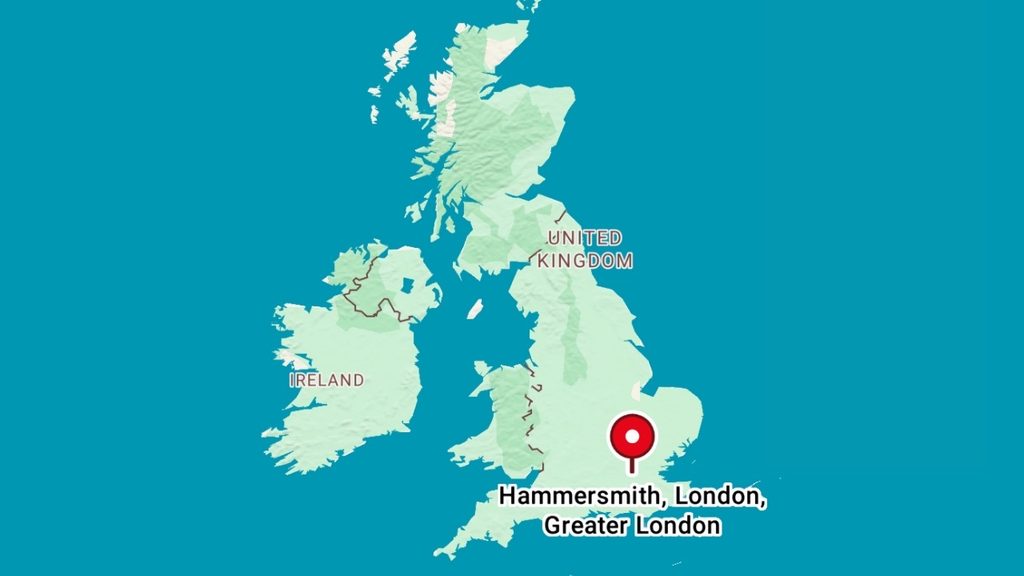
At the beginning of the nineteenth century, Hammersmith was still a village on the western outskirts of London, separated from the expanding capital by fields, open ground, and stretches of countryside. Its lanes could be dark after sunset, and beyond the reach of scattered lamps it was often difficult to make out exactly who, or what, might be standing ahead.
It was the perfect setting for a ghost story, and by the end of 1803, Hammersmith had become a place where many people were genuinely afraid of the dark.
The first reports began during the autumn. Strange figures were reportedly seen around Hammersmith churchyard and along the nearby lanes. One of the earliest accounts concerned a figure dressed in unusual clothing, which some witnesses believed to be a woman wandering in a disturbed state. The sightings were vague, but they were enough to fuel speculation, and rumours quickly began to circulate about what people were encountering after nightfall.
As the stories spread, so did the descriptions.
A second apparition was soon reported. Witnesses described a figure dressed entirely in white which appeared suddenly before vanishing again before anyone could identify it. The figure was said to move quickly and seemed remarkably difficult to catch. Some residents became convinced that it was the spirit of a man who had died by suicide and been buried in the churchyard. At the time, many people believed those who took their own lives could not rest peacefully if buried in consecrated ground. If that belief was true, some reasoned, perhaps the dead man had returned to wander among the living.
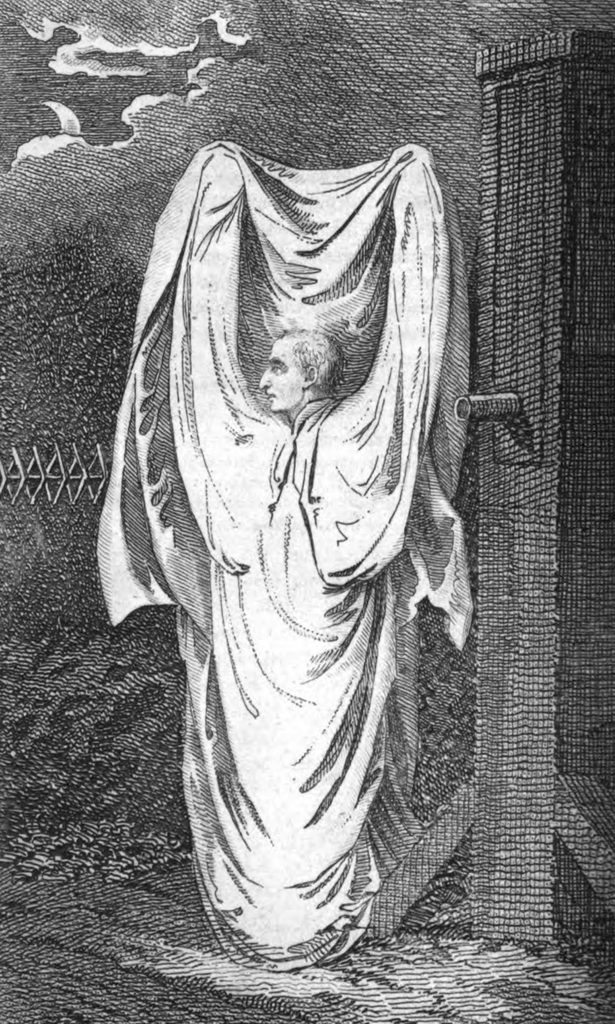
Other descriptions were even more alarming. In some accounts, the apparition appeared as a creature wearing something resembling an animal skin and sporting horns and large glass-like eyes. The details changed depending on who was telling the story, but the central theme remained the same. Whatever was haunting Hammersmith was no longer being treated as a harmless curiosity. Increasingly, it was beginning to frighten people.
Stories soon emerged of people being approached, attacked, or terrorised by the apparition. One tale concerned an elderly woman who reportedly encountered the ghost near the churchyard. Another involved a pregnant woman who was said to have been seized while walking after dark. Rumours circulated that both women later died as a result of the shock they had suffered. Whether those reports were true is impossible to know, but they were repeated often enough to deepen the growing sense of fear.
Then came an incident that appeared to involve more than a fleeting sighting. Thomas Groom, a servant employed by the local brewers Burgess and Winter, was walking through the churchyard with another man at around nine o’clock one evening when something suddenly grabbed him around the throat. Groom struggled with whatever had seized him and reached towards it, attempting to identify his attacker. But when his companion looked back towards him, there was apparently nothing there.
Groom reported feeling something soft beneath his hand, similar to a greatcoat, before the figure apparently disappeared.
By this point, the ghost was no longer confined to the churchyard. Reports placed it throughout the surrounding area, including Beavor Lane, Black Lion Lane, and Plough and Harrow Lane.
Among those said to have encountered the apparition was a drummer serving with the Chiswick Volunteers who also worked as a rat catcher. Another story involved a brewer’s clerk who believed he had seen something supernatural while walking through Plough and Harrow Lane during the early hours of the morning.
The tales continued to grow.
One report claimed the apparition had interfered with a coach and frightened those travelling inside it. Others described people being pursued through dark lanes, confronted without warning or otherwise terrified by the mysterious figure. With each new retelling, it became harder to distinguish one sighting from another. Hammersmith appeared to have acquired not merely a ghost, but an entire collection of ghost stories.
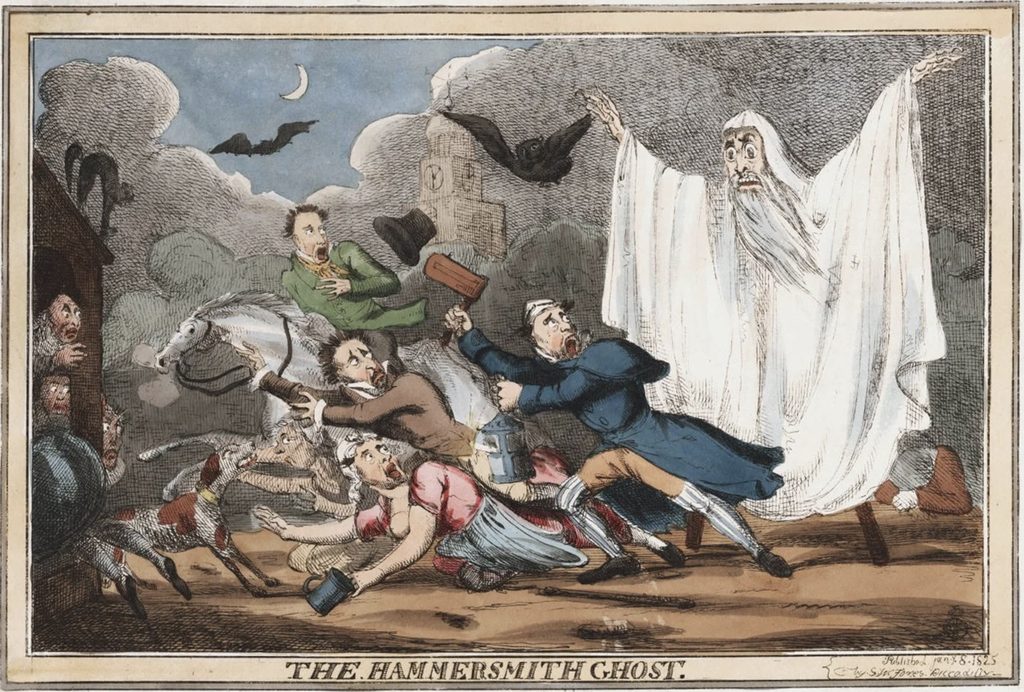
Then, on 29th December 1803, the apparition was seen by William Girdler, a local night-watchman. Girdler was near Beavor Lane when he noticed an apprentice boy running across the road in obvious distress. Looking towards the place the boy had come from, Girdler spotted a figure dressed in white. As he moved towards it, the figure immediately fled.
Convinced he had finally encountered the mysterious apparition, Girdler gave chase through the darkness. During the pursuit, he later reported seeing the figure remove what appeared to be a sheet or tablecloth, bundle it beneath its coat and continue running. Despite his efforts, he eventually lost sight of the suspect.
Others apparently witnessed parts of the incident. People at a nearby house reportedly noticed a piece of white material hanging beneath the figure’s coat, while residents in the area were alarmed by the commotion caused by the chase.
For those who had spent weeks listening to stories about the Hammersmith Ghost, the incident was hardly reassuring.
Whatever the explanation, something had been moving through the streets at night dressed in white. And if the apparition was actually a person, then somebody was deliberately frightening the residents of Hammersmith.
The encounter also marked a turning point in the growing panic. Following Girdler’s sighting, local men began organising armed patrols in the hope of catching whoever was responsible. Rewards were reportedly offered for the capture of the ghost, although contemporary accounts differed on the exact amount. Some reports claimed two clergymen each offered 5 guineas, while others referred to a reward of £20. What remains unclear is whether those offering the money believed they were pursuing a genuine apparition or simply someone carrying out an elaborate hoax.
By the end of December, the Hammersmith Ghost had become far more than a local rumour. People were no longer content merely to discuss it or report sightings. They were actively hunting it. The fear had become real, regardless of what was causing it.
As the new year began, one of those hunters would take a loaded gun into the darkness.
Within days, a man would be dead.
Thomas Millwood
Thomas Millwood was about 22 years old and worked as a bricklayer in Hammersmith. He lived locally with his wife, and there was nothing especially remarkable about his life. He was a young working man, earning his living and going about the ordinary routines of married life.
Unfortunately, Thomas possessed one characteristic that made him stand out in a village already gripped by fear: he worked in white clothes.
His work attire consisted of white trousers, a very white flannel waistcoat and an apron worn around his body. By this stage of the ghost panic, that was enough to make him resemble the mysterious figure people claimed to be seeing in the darkness.
In fact, Thomas had already discovered this for himself. A few days before his death, he was at home with his mother-in-law, Phoebe Fullbrook, when he told her about an earlier encounter. While wearing his work clothes, he had apparently frightened two women and a man travelling in a carriage. According to Mrs Fullbrook’s later testimony, the man looked at Thomas and exclaimed, “There goes the ghost.“
Thomas’s response was considerably less supernatural. Mrs Fullbrook recalled that he told the man he was no more a ghost than he was and then asked whether he wanted “a punch o’ the head.“
She was far less amused by the situation than her son-in-law. With so much talk of the apparition spreading through Hammersmith, she warned Thomas to wear his greatcoat over his white working clothes whenever he went out at night. It was sensible advice, but Thomas apparently ignored it.
On the evening of 3rd January 1804, there was nothing unusual about the reason he was out. Earlier that evening, he had been visiting his father’s house on Black Lion Lane, where he spent time with members of his family, including his sister Anne.
As the evening wore on, Anne encouraged him to collect his wife, who was working at a nearby house. She was concerned that Thomas’s wife would otherwise have to make the journey home alone. Thomas agreed and set off through Hammersmith.
By then, everyone in the village knew about the ghost. The stories had circulated for weeks, and the appearance of armed patrols had made the situation impossible to ignore. Thomas was well aware of the rumours and the fear they had created.
What he could not have known was that, on this particular night, his route home would bring him into the path of one of the men searching for the apparition.
As Thomas continued along the road, somebody nearby was standing watch. He was armed, nervous and waiting for the ghost to appear.
Within minutes, Thomas Millwood would walk directly into his line of sight.
Francis Smith
Francis Smith was 29 years old and worked as an excise officer, collecting government duties on taxable goods. He lived in Hammersmith with his wife and children and, like everyone else in the village, he had heard the stories surrounding the ghost.
On the evening of 3rd January, Smith visited the White Hart, a local public house. While he was there, conversation turned to the apparition and the ongoing efforts to identify whoever, or whatever, had been frightening local residents. At some point during the evening, Smith decided he would join the search himself.
After obtaining a gun, he set out into the night. At around 10:30 pm, he encountered William Girdler, the night-watchman whose earlier pursuit of a white-clad figure had helped fuel the growing panic. The two men met near Beavor Lane and spoke about the ghost. Smith told Girdler that he intended to look for it.
Girdler was armed as well. He later testified that he always carried a pistol while carrying out his duties as a night-watchman. Aware of the danger of mistaking one another for the apparition in the darkness, the two men agreed upon a password they would use if they met again during the night:
“Who comes there?”
“A friend.”
“Advance, friend.”
With that, the men parted company. Girdler continued his patrol, while Smith headed towards Black Lion Lane, one of the locations most commonly associated with sightings of the ghost.
The Shooting of Thomas Millwood
Smith took up a position in Black Lion Lane and waited. It was shortly after 11:00 pm when he noticed someone approaching through the darkness. The figure was dressed in white.
It was Thomas Millwood.
The lane itself offered poor visibility. Enclosed by hedges and only around four yards wide, it was one of the darker parts of the village. Later, a witness named John Locke told the court that even on a comparatively light night it would have been difficult to see somebody clearly on the opposite side of the lane.
As the figure approached, Smith called out.
From the doorway of her family’s house nearby, Anne Millwood later recalled hearing a voice shout, “Damn you, who are you, and what are you? Damn you, I will shoot you.“
Smith would later claim that he called to the figure twice but received no reply. He also told John Locke afterwards that the figure continued moving towards him, increasing his belief that he was confronting the dreaded apparition.
Then he pulled the trigger.
The shot struck Thomas in the left side of the lower jaw. The pellets caused a fracture, and one penetrated a vertebra in his neck, damaging his spinal cord. The injuries were fatal. Thomas died almost immediately.
Hearing the gunshot, Anne ran towards her brother and found him lying dead.
Smith had gone out into the darkness believing he was hunting a ghost. Instead, he had shot and killed a young man from his own village.
Thomas’s body was carried to the nearby Black Lion Inn, where a surgeon named Mr Flower examined him.
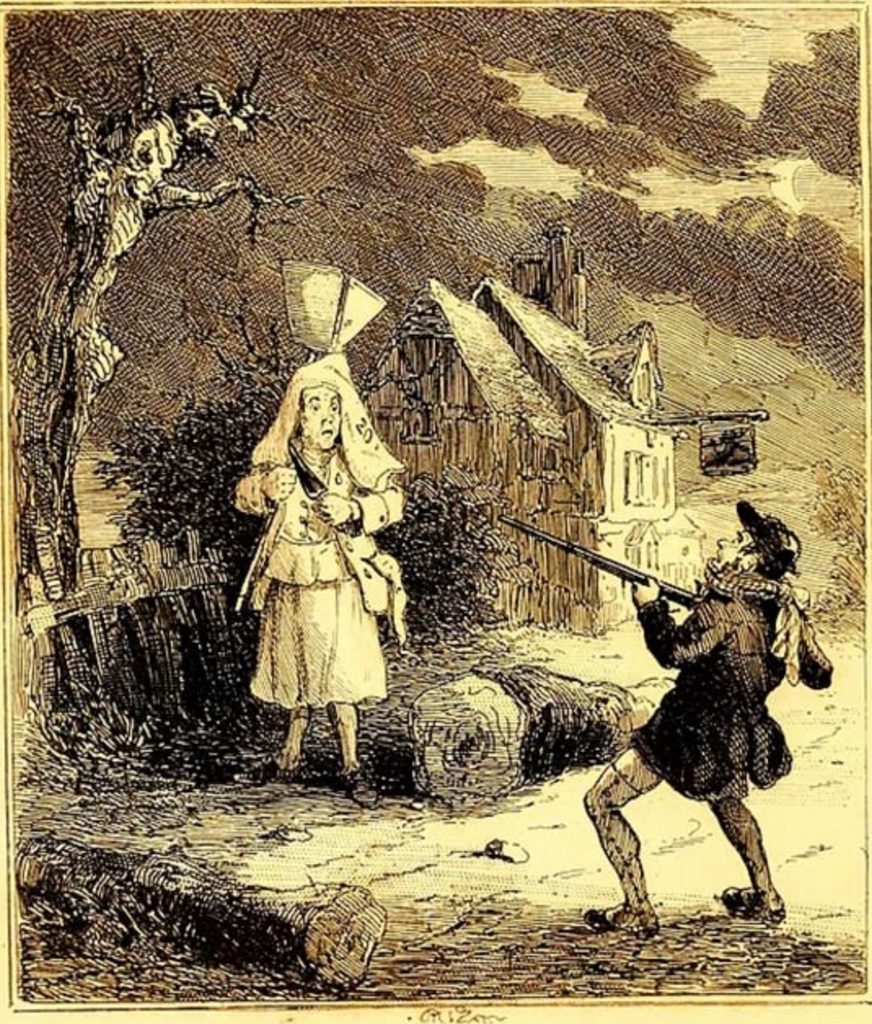
In the aftermath of the shooting, witnesses described Smith as deeply distressed. John Locke later told the court that he was so agitated he could barely speak. Smith admitted firing the shot but said he had not known who he was shooting at because the night was so dark. He also repeated that he had challenged the figure twice and received no answer.
Initially, Smith wanted to surrender himself immediately. Although he was advised to return to his lodgings, he made no attempt to evade responsibility. When the authorities arrived, he surrendered without resistance.
The man who had set out believing he was hunting the Hammersmith Ghost was now facing a charge of murder. Smith did not deny killing Thomas Millwood. Instead, he insisted that he had genuinely believed he was confronting the apparition that had terrified Hammersmith for weeks.
The question now facing the court was whether that belief could excuse the killing.
The Trial of Francis Smith
Just ten days after Thomas Millwood was killed, Francis Smith stood trial at the Old Bailey charged with his murder.
The prosecution’s case was straightforward. Smith had armed himself with a loaded gun, gone out into the streets of Hammersmith in search of the supposed ghost, challenged Thomas Millwood and then shot him dead.
What made the case unusual was that Smith did not argue that the shooting had been accidental. Instead, he maintained that he genuinely believed Thomas was the Hammersmith Ghost.
As a result, the court heard extensive evidence about the extraordinary fear that had taken hold of Hammersmith in the weeks before the shooting. Witnesses described the apparitions people claimed to have seen, the rumours that had spread through the village and the measures residents had taken to protect themselves. The circumstances surrounding the shooting were therefore unusually important in understanding Smith’s actions.
There really had been a ghost panic. People really had reported seeing a figure dressed in white. Some witnesses claimed to have been attacked or terrorised by it, while local men had begun patrolling the streets armed with pistols and guns. Smith had not invented the stories, nor had he imagined the fear that had taken hold of the village.
At the same time, there was a very real victim at the centre of the case. Thomas Millwood had not been a ghost, and he had not been threatening Smith. He was a young working man walking through his own village to collect his wife when he was shot and killed.
Anne Millwood also gave evidence about the events of that night. She had been standing at the doorway of the family home when her brother left and later heard Smith’s challenge immediately before the gun was fired.
The jury also heard evidence regarding Smith’s character. John Locke described him as a mild and humane man who was generally well regarded, while William Girdler said he had always known Smith to be good-tempered. In addition, the defence called twelve character witnesses who spoke positively about him. Smith himself continued to insist that he had never intended to kill another human being. He believed he was confronting the figure that had frightened Hammersmith for weeks.
The central question facing the court was therefore not whether Smith had fired the gun. There was no dispute about that. The question was whether his mistaken belief could make the killing something other than murder.
For the defence, everything came back to the same point. Smith’s actions could not be separated from the widespread belief that Hammersmith was being haunted.
But Chief Baron Sir Archibald Macdonald took a different view. The fact that Smith believed he was shooting the ghost did not, in itself, make the killing lawful. Smith had deliberately fired the gun, and there was no evidence that Millwood had attacked him or posed an immediate threat. Furthermore, Smith had gone out specifically looking for the ghost rather than unexpectedly encountering danger.
Even if the figure had actually been the person responsible for frightening residents, the judge explained, that would not have justified shooting them. Pretending to be a ghost was not an offence serious enough to warrant the use of deadly force. Macdonald therefore directed the jury that, if they accepted the prosecution’s evidence, they should find Smith guilty of murder.
The jury retired to consider its verdict.
When the jurors returned, however, they found Smith guilty of manslaughter.
The judge was not prepared to accept that conclusion. According to Macdonald, there was nothing in the facts of the case capable of reducing the killing from murder to manslaughter. If the jury rejected the prosecution’s evidence, they could acquit Smith. If they accepted it, they were required to convict him of murder.
The jury withdrew for a second time. When they returned, they delivered a verdict of guilty of murder.
Francis Smith was sentenced to death by hanging. His execution was scheduled for the following Monday, after which his body was to be handed over to surgeons for dissection.
But Smith would never be hanged.
When the verdict was announced, he reportedly broke down in the dock. The Lord Chief Baron, who had already recognised the unusual circumstances surrounding the case, informed the jury that he intended to report the matter to the King. Before the day was over, Smith’s execution had been formally respited.
On 25th January 1804, King George III granted a royal pardon. Smith’s death sentence was commuted to one year of imprisonment with hard labour.
For Smith, the immediate question of whether he would die for killing Thomas Millwood was therefore settled. The case itself, however, was far from over.
The circumstances that had led him to pull the trigger exposed something much more complex than a straightforward killing. Hammersmith really had been gripped by fear. People really had reported seeing a ghost. Some had deliberately encouraged those fears, while others had sincerely believed them.
And in the middle of it all, Thomas Millwood had died.
But the question raised by Smith’s belief would ultimately outlive both the panic and the ghost itself.
The Truth Behind the Hammersmith Ghost
By the time Francis Smith appeared at the Old Bailey, the Hammersmith Ghost had effectively become part of the evidence. The stories of strange apparitions, terrified witnesses and armed patrols helped explain why Smith believed he was hunting something dangerous. The obvious question, however, was what had actually been happening in Hammersmith.
The answer is more complicated than simply saying there was no ghost. There were several separate incidents behind the rumours, and not all of them appear to have had the same explanation.
Some sightings were eventually given entirely ordinary explanations. According to a later account in Kirby’s Wonderful and Eccentric Museum, one of the earliest ‘apparitions’ was identified as a butcher’s employee who had been wearing women’s clothing as part of a prank intended to tease a female fellow servant.
In another incident, a chimney sweep who approached a supposed ghost near Church Lane discovered it was simply a young woman accompanied by a companion. There is no indication that she had been attempting to impersonate a ghost. More likely, she had simply been mistaken for one in the darkness.
Other reports were harder to explain. Thomas Groom genuinely believed something had seized him by the throat in the churchyard, yet he never identified the person responsible, and there was certainly no proof that the attacker had been supernatural.
Meanwhile, several of the more dramatic stories that circulated through Hammersmith later appeared to be little more than rumours or newspaper embellishments. One popular tale claimed that a woman at Brooke Green had died after being frightened by the ghost. Later accounts suggest this was untrue and that the woman had actually been frightened by an intoxicated individual rather than any mysterious apparition.
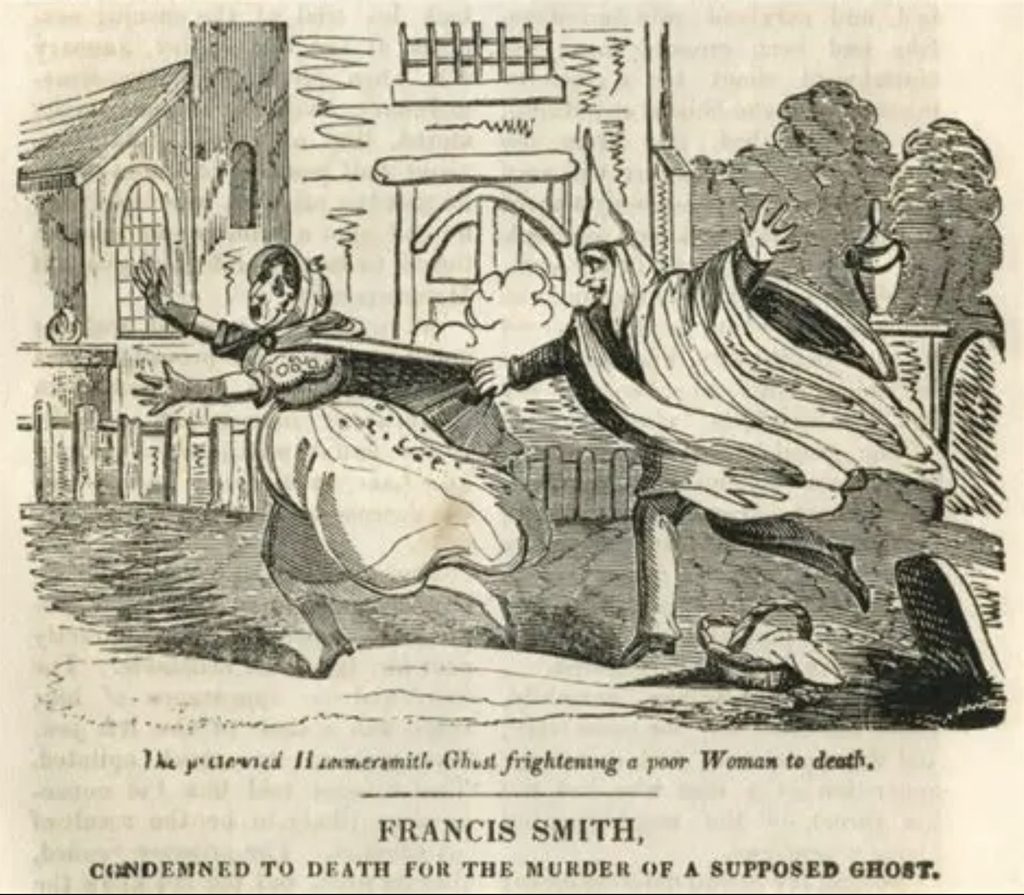
Similarly, stories circulated about horned apparitions terrorising travellers, and a coachman who had become so frightened by the apparition that he lost control of his horses and endangered his passengers. Later accounts dismissed these stories as lacking any solid foundation, with the coach incident described as a newspaper invention.
By the end of 1803, the Hammersmith Ghost had become a patchwork of practical jokes, mistaken identity, frightened witnesses, and increasingly elaborate storytelling.
Then came the incident involving William Girdler.
On 29th December 1803, the night-watchman saw an apprentice boy running across the road in alarm and spotted a white-clad figure near Beavor Lane. Girdler gave chase and later claimed he saw the figure remove its white covering and bundle it beneath its coat before disappearing into the darkness. But this particular ghost had a surprisingly ordinary explanation.
A local shoemaker named John Graham eventually confessed that he had been the man in the sheet. According to Graham, he had disguised himself in white specifically to frighten his apprentice. The boy had been scratching the walls of Graham’s house and frightening his children with stories about ghosts and apparitions. Graham decided to repay the favour by giving the apprentice something to be frightened of himself. The figure Girdler had chased through the streets had not been a ghost at all, but a man playing a practical joke.
Suddenly, one of the most convincing ghost sightings in the entire affair had an entirely ordinary explanation. Even so, Graham’s confession did not explain everything that had happened in Hammersmith during the preceding months. There had been other sightings, other frightened witnesses, and other unexplained encounters, some of which were later accounted for and some of which remain uncertain.
What the confession did demonstrate, however, was that the Hammersmith Ghost did not need to be real to become dangerous.
People were already expecting to see something. A figure dressed in white could become a ghost. A frightened witness could become evidence of an attack. A rumour could become accepted fact. An uncertain sighting could grow into something more elaborate with each retelling.
By the end of December 1803, the residents of Hammersmith were no longer simply reacting to what they had seen. They were actively looking for the ghost they had been told was there. And when Francis Smith stepped into the darkness with a loaded gun on 3rd January 1804, that was exactly what he expected to find.
Conclusion
The Hammersmith Ghost case raised a question that would remain part of British legal debate for generations: what should happen when someone uses force because they genuinely believe they are facing a threat, only to discover they were mistaken about the circumstances?
In Francis Smith’s case, the answer was clear. His belief that Thomas Millwood was the Hammersmith Ghost did not justify shooting him.
Nearly two centuries later, the courts finally clarified the broader principle in R v Williams (Gladstone) in 1983. The Court of Appeal held that a person who genuinely believes circumstances exist that would justify the use of force must be judged according to the facts as they honestly believed them to be. The fact that the belief later turns out to be mistaken, or even unreasonable, does not automatically make the use of force criminal.
Williams was not an appeal of Smith’s conviction, nor did it overturn the decision reached at the Old Bailey in 1804. The law had evolved through numerous cases in the intervening years. Nevertheless, the question at the heart of the case echoed the same issue raised by the Hammersmith Ghost almost 180 years earlier: how far can someone go when they genuinely believe they are protecting themselves or others?
The Hammersmith case offers a grim answer. Francis Smith believed there was a dangerous figure moving through the streets of his village. He believed he was confronting the Hammersmith Ghost. But instead, he found a man.
Sources and Further Reading
Kirby’s Wonderful and Scientific Museum, Vol. II (1804) | R. S. Kirby | Digitised copy via the University of Illinois Urbana-Champaign
Library of Congress | The Case of a Ghost Haunted England for Over Two Hundred Years
Newgate Calendar | Francis Smith: Condemned to Death on 13th of January, 1804, for the Murder of the supposed Hammersmith Ghost, but pardoned soon afterwards
Proceedings of the Old Bailey | Francis Smith
Image Credits:
Book of English Trades, or Library of Useful Arts (1821) | F. C. & J. Rivington | Available at the Library of Congress
Chronicles of Crime; or, The New Newgate Calendar (1841) | Camden Pelham | Digitised copy
The Hammersmith Ghost, 1825 | S.W. Fores | Satirical print, published 8th January 1825, attributed to Henry Heath
Wikimedia Commons | Thomas Webster – English Pub
Wikimedia Commons | The Old Bailey, 1808