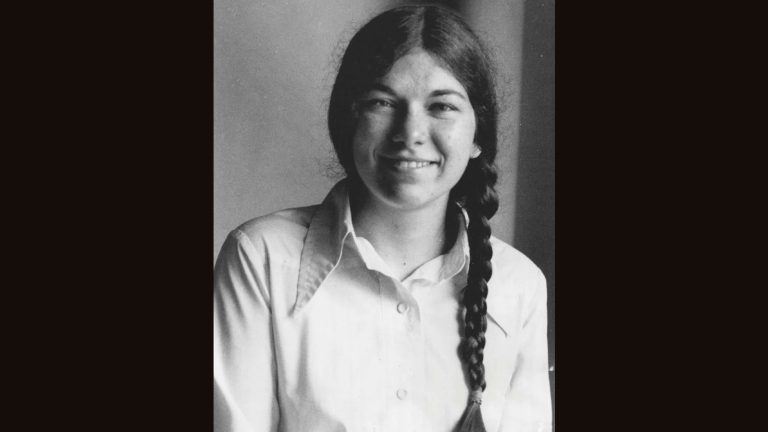
On Halloween night in 2003, Heather Stephenson-Snell travelled from York to Radcliffe in Greater Manchester wearing a white sheet and a Scream-style mask. Beneath the costume, she carried a loaded, sawn-off shotgun, and she had come with one purpose: to kill Diane Lomax, the woman who had become the focus of her resentment.
For months, Heather had subjected Diane and Adrian to harassment, threats, and malicious allegations. Now she had taken the next step, carefully planning the attack and her escape. But when she finally reached her destination, the plan did not unfold as she expected.
Heather Stephenson-Snell
Heather Stephenson-Snell was born on 2nd December 1957 in Malta to British parents. Her father served in the British armed forces, and her early childhood was shaped by his postings and the family’s frequent moves. When Heather was 7, her parents’ marriage broke down completely, and her mother moved to Canada with Heather and her brother. They remained there for six years before returning to Britain. At 13, Heather was sent to a boarding school in Kent, but she hated it and soon moved to Scarborough, North Yorkshire, where she lived with an aunt. By then, her relationship with her mother had broken down, while her father played no role in her life.
Heather left school with five CSEs and went straight into work. Her first significant job was at a local motor garage, where she developed an interest in machinery, engineering and vehicles.
During her late teens and early adulthood, Heather was also drinking heavily, and this brought her into trouble with the police. She accumulated a number of convictions for relatively minor offences, including petty theft and criminal damage. Although none resulted in a custodial sentence, she was reportedly reaching the point where any further offending could have resulted in one.
Things began to settle when Heather found work at a bookshop in Scarborough, run by a man called Leo Snell. The two became involved, married in 1978 and had a son, Solomon, the following year.
Heather and Leo eventually moved to Penrith in Cumbria, where they opened an art gallery and bookshop and attempted to build an artistic, bohemian lifestyle. Their marriage was not a happy one, however, and by 1983 the couple had divorced. Leo left, while Heather remained for a little while in Cumbria and began to pursue new directions in her life.
Although she had left school with relatively few qualifications, Heather believed she was capable of academic study and enrolled on an Introduction to Social Sciences course through the Open University. She subsequently secured a place at the University of York, where she studied psychology and graduated with a BSc in 1990. She went on to complete postgraduate training in counselling and, in 1991, opened the York Psychotherapy Clinic.
For thirteen years, Heather ran her practice as a registered counsellor and psychotherapist, specialising in art therapy. She eventually moved both her home and work to Crombie Avenue in Clifton, York. To the patients who visited her, she was a professional woman whose work centred on understanding the problems and emotions of others. In the garden stood a serene Buddha statue, while elsewhere on the property Heather had created a very different kind of environment.
She had a strong interest in motorcycles and attended rallies around the region. She founded an all-female motorcycle club called ‘Stuff The Ironing’, and had converted her garage into a social space known as the Orange Pit, where her female biker friends would gather. Accounts of Heather’s life in that circle also described her as someone who told elaborate stories about herself and her connections, presenting a more colourful and sometimes more extraordinary version of her life to those around her.
She also had a fascination with weapons, keeping knives, daggers, replica swords, and firearms at her home. The property itself was heavily secured, with six-foot-high gates and barbed-wire fencing, and Heather lived there with two protective Rottweilers, including her much-loved dog, Sammy.
By 2002, Heather presented a striking combination of identities: psychotherapist, business owner, biker, animal lover, and weapons enthusiast. To many people, she appeared intelligent, independent and unconventional, a woman who had repeatedly reinvented herself throughout her life. Few who encountered her professionally would have imagined that she would eventually travel across the Pennines carrying a shotgun with the intention of killing another woman.
That changed when Adrian Sinclair entered her life.
Adrian Sinclair
Heather needed somebody trustworthy to look after her dogs while she was busy attending to her patients during the day. To find help, she placed an advertisement in The Big Issue. Adrian Sinclair responded. Described as handsome and physically charismatic, he had previously worked as a male stripper and appeared in adult videos. He was also dealing with mental-health difficulties and was looking for both accommodation and employment when he answered Heather’s advert. After meeting Heather, he was hired as a live-in dog sitter at her home on Crombie Avenue.
The arrangement soon became more complicated. Adrian and Heather entered into a sexual relationship, but it was brief and increasingly turbulent. Heather became possessive and controlling, attempting to influence aspects of Adrian’s life well beyond his responsibilities at the house. She even warned him that she would hurt any woman he became involved with.
Heather also introduced Adrian to the other side of her life. She showed him the Orange Pit, where he discovered that drinking and drugs were also part of the party-going biker scene she was involved in. She showed him her collection of weapons and boasted about her previous offending and about people she claimed to have attacked for crossing her in the past.
Given the threats she’d already made, it’s hardly surprising that Adrian was becoming increasingly uneasy around her.
But strangely, Heather was also the one who appeared to bring the arrangement to an end. She decided Adrian was unsuitable to look after her dogs and made it clear that he was no longer welcome.
When Heather travelled to the United States to take a three-month writing course, Adrian saw an opportunity to move out. He packed his belongings and moved to the Radcliffe area of Greater Manchester, where he met Diane Lomax.
Diane was a mother of two young boys, and she and Adrian were introduced through mutual friends. Their relationship quickly became serious, and before long Adrian moved in with Diane and her children at number 59 Holland Street.

Heather was still in New York when she discovered that Adrian had left York and was now involved with another woman, and she was not willing to accept that the relationship was over. Diane had now become the woman at the centre of a relationship Heather was unwilling to let go of. And Heather had already warned Adrian what could happen to the next woman he became involved with.
The Harassment
Heather was still in New York when she started sending Adrian messages that would switch between sexual one minute and threatening the next. Before leaving for America, she had also taken his address book, giving her the contact details of his friends and family, and she began calling them as well, making bizarre accusations about him.
Diane became a target too. Heather left abusive messages for her, calling her things like a prostitute and a slag.
Adrian didn’t want the situation to continue like this. He seems to have hoped that he and Heather could make peace and bring things to an amicable end, so when Heather returned from America, he agreed to meet her at her home on Crombie Avenue. But while he was there, the two slept together.
Adrian immediately regretted what had happened. As far as he was concerned, it was a one-off encounter, not a reconciliation, and afterwards he returned to Diane in Radcliffe.
But if Adrian hoped that making peace with Heather would bring an end to the calls and threats, it didn’t. Instead, the harassment escalated. For months, Heather would repeatedly attempt to disrupt Adrian and Diane’s relationship and upend their lives.
The couple received hundreds of telephone calls. Some were abusive, while others contained explicit threats. The calls became a constant feature of daily life, with the telephone ringing repeatedly at all hours of the day and night. Through her actions, Heather made it clear that she had not accepted Adrian’s decision to leave York and start a new relationship.
Around Christmas 2002, Diane received a card containing a photograph of Adrian kissing another woman. The woman’s face had been scratched away, leaving the image deliberately defaced. The message was unsettling, particularly when viewed alongside the threatening calls and other unwanted contact the couple had already endured. At one point, Heather even threatened to cut off Diane’s breasts.
Heather’s harassment continued, going so far as following Diane and her children as they walked to school and photographing them in the street. Eventually Adrian and Diane moved with the children to Huddersfield, around thirty miles away. But the move did not stop her. Heather somehow discovered where they were staying and called them, reportedly asking:
“What’s the weather like in Huddersfield?”
Wherever they moved, Heather managed to track them down.
She then turned to the authorities, making a series of malicious allegations to Greater Manchester Police and other agencies concerning Diane’s children, accusing both Adrian and Diane of paedophilia in an apparent attempt to trigger a child protection investigation. She also contacted North Yorkshire Police, claiming that Adrian had stalked her and threatened to kill her.
The result was a confusing web of accusations spanning two police force areas. Heather presented herself to police as the victim of a dangerous and abusive former partner, while Adrian and Diane found themselves repeatedly responding to serious allegations.
Then, in the spring of 2003, everything stopped.
The telephone calls ceased. The threats ended.
After months of intimidation, Adrian and Diane believed that Heather had finally accepted the end of the relationship and moved on with her life.
But she hadn’t.
By then, she was preparing for something far more serious.
Preparing for Murder
Heather Stephenson-Snell began taking shooting lessons at the North of England Activity Centre at Rufforth, near York. Over a period of several weeks, she attended four half-hour clay-pigeon shooting lessons, during which she was taught to use an over-and-under shotgun.
Her instructor, Ken Whelan, later described her as a slow learner who struggled with the technical aspects of shooting. Heather herself would later acknowledge that she found handling the weapon difficult. Nevertheless, she persisted with the lessons.
At the same time, she was making journeys from York to Radcliffe and covertly studying the area around Holland Street. She familiarised herself with the layout of the street, noting parking patterns, the positions of streetlights and the location of nearby alleyways. She also studied Diane Lomax’s terraced house, estimating the distance between the pavement and the front door and identifying potential escape routes.
Heather also bought an old red Ford Escort, which she registered under a false name. She arranged for other possible escape vehicles, including a mountain bike and a motorbike, to be positioned at different locations across North and West Yorkshire, with at least one left at the home of a friend. The prosecution would later argue that these vehicles formed part of her escape plan, allowing her to abandon the Escort and continue her journey using alternative transport if necessary.
Heather also prepared a series of detailed handwritten index cards. Numbered and colour-coded, they contained instructions for her journey from York to Radcliffe and the planned return journey, complete with roads, motorway junctions, and mileages. Some bore titles such as “In Position” and “Return Early,” while others contained checklists of items she intended to carry, including disguises, weapons, and ammunition.
One phrase was particularly significant: “Ade Frame.”
The prosecution argued that the phrase referred to Adrian Sinclair and reflected an intention to frame him for Diane Lomax’s murder. Taken together, the cards suggested that Heather was not acting on impulse. She had considered the practical details of travelling to Radcliffe, carrying out the attack, and leaving the area afterwards.
The shooting lessons, reconnaissance trips, vehicles, and handwritten instructions would all become important evidence of premeditation.
Then came Halloween.
Halloween 2003
Shortly after midnight on 31st October 2003, Heather Stephenson-Snell arrived outside 59 Holland Street in Radcliffe. Dressed in Adrian’s clothing, she was wearing a white sheet and a Scream-style mask. Concealed beneath the costume was a sawn-off shotgun.
Inside the terraced house, Diane Lomax was at home with her children. Halloween was drawing to a close, and the family were settling down for the night.
Heather began banging heavily on the front door.
Diane did not answer.
Instead, she looked through the spyhole and saw the masked figure standing outside. After months of threats and harassment, she had little intention of opening the door. She remained inside.
The knocking continued.
Standing in the darkened hallway, Diane watched as the figure refused to leave.
Next door, at number 61, Robert Wilkie heard the disturbance. Wilkie was staying with his partner, Debbie O’Brien. Four children were inside the house, and he was concerned that the noise would wake them.
He stepped outside to investigate.
Wilkie had no reason to believe the masked stranger was armed.
Assuming it was a Halloween prank or a group of late-night trick-or-treaters, he told the figure that his children were trying to sleep and suggested she go home. Instead, Heather replied:
“Go back inside and mind your own business.”
When Wilkie asked her to remove the mask and identify herself, she refused.
So he pulled it off.
Watching through the spyhole, Diane gasped as the face beneath the mask was revealed.
It was Heather Stephenson-Snell.
For Diane, the sight was instantly recognisable.
For Robert Wilkie, it meant nothing.
He had never met Heather before. He had no idea who she was, why she was standing outside number 59, or why she had travelled to Holland Street in the middle of the night. To him, she was simply a masked stranger causing a disturbance.
To Heather, however, Robert Wilkie was the only thing standing between her and the woman she had spent months planning to murder.
With her disguise compromised and Wilkie standing between herself and Diane, she reached beneath the white sheet, drew the shotgun, and fired.
The blast struck Wilkie at point-blank range in the stomach.
The weapon’s recoil caused serious injuries to Heather’s face, resulting in bruised eyes and a deep gash across her cheek. Wilkie collapsed onto the pavement while Diane watched helplessly from inside her home.
Robert Wilkie died on Holland Street.
The man who had gone outside to quieten a disturbance had become the victim of a murder that was never intended for him.
Robert Wilkie
Born on 1st December 1959, 43-year-old Robert “Bob” Wilkie had served as a commando in the British armed forces before settling in Radcliffe, where he worked as a landlord running local pubs. As a publican, Wilkie was known for his warmth and ability to manage a crowded room. He knew how to handle difficult situations without resorting to unnecessary conflict.
Although he owned a flat in Crompton Close, Wilkie spent much of his time at the Holland Street home of his partner, Debbie O’Brien, her two children, aged 14 and 9, and the couple’s two foster children. The couple had been together for several years.
Wilkie had become an important part of the children’s lives, and Debbie later described him in court as, “Just so kind and caring, and very generous.”
He was also looking forward to a future with her. Shortly before his death, Wilkie had formally asked Debbie’s father for permission to marry her, and the family had begun making wedding plans.
There had also been a reconciliation within his own family. Wilkie and his older brother Billy had been estranged for several years following a serious falling-out, but just weeks before his death the brothers met again and resolved their differences.

On Halloween night, Wilkie was surrounded by the people he loved and preparing for the future he had worked hard to build.
Instead, he stepped outside to investigate a disturbance and crossed paths with Heather Stephenson-Snell.
And he lost his life.
All because he happened to be next door.
Heather’s Escape
After shooting Wilkie, Heather ran back to the red Ford Escort and drove away from Radcliffe, heading towards the Pennines.
At around 1:30 am on 1st November 2003, two West Yorkshire Police officers were patrolling the M62 when they noticed a red Ford Escort travelling eastbound. What attracted their attention was not excessive speed or erratic driving, but the opposite. The vehicle appeared to be crawling along the inside lane at an unusually slow speed, creating a potential hazard for other road users.
Concerned that the driver might be intoxicated, exhausted, or otherwise impaired, the officers stopped the car on the hard shoulder.
Behind the wheel was a middle-aged woman with a fresh facial injury.

The weapon’s recoil left a wound to her face
Heather gave the officers a false name, but there was little she could do about what was inside the vehicle.
In the back of the Escort, officers found the blood-stained ghost costume, together with a loaded sawn-off shotgun and ammunition. After ordering Heather out of the car, they conducted a search and discovered a dagger tucked into the waistband of her trousers. Further knives and ammunition were recovered from the door pockets and glove compartment.

(Credit: Manchester Evening News)
Heather was arrested.
The getaway she had spent months preparing for had lasted little more than an hour.
The Investigation
Following her arrest, Heather provided several differing accounts to explain both her presence in Radcliffe and the weapons found in her vehicle.
Initially, she told police that the shotgun, ammunition, and other weapons did not belong to her. She claimed they had been left in the car by a boyfriend and that she had been unaware they were there. At this stage, she denied any knowledge of the shooting.
When investigators challenged her account with evidence placing her on Holland Street, she altered her explanation. She acknowledged travelling to Radcliffe to confront Diane Lomax, but claimed she had arrived unarmed. According to this version of events, it was Diane who had produced the shotgun during an altercation, and Heather had wrestled it away before fleeing with the weapon.
Forensic examination of the shotgun, however, identified DNA from Heather and Robert Wilkie, but none from Diane Lomax. Investigators considered this inconsistent with Heather’s account.
Police also established that Heather had attended shooting lessons at a firearms centre near Rufforth in the months before the attack. The lessons began around the same time that the harassment of Adrian and Diane ceased in spring 2003.
A search of her residence on Crombie Avenue, York, uncovered additional weapons. Further searches of her home and vehicle revealed the handwritten index cards containing notes about routes between York and Radcliffe, motorway escape junctions, and her plans to swap vehicles.
Among the notes was the phrase “Ade Frame,” which prosecutors argued supported their case that Heather had intended not only to kill Diane Lomax but also to direct suspicion towards Adrian Sinclair.
Taken together, the physical evidence, forensic findings, and planning materials formed a central part of the prosecution case that the attack had been planned in advance.
The Trial
Heather Stephenson-Snell went on trial at Manchester Crown Court in September 2004, charged with the murder of Robert Wilkie and the attempted murder of Diane Lomax.
The prosecution’s case was straightforward. Heather had travelled from York to Radcliffe with the intention of killing Diane, and Robert Wilkie had been shot only because he intervened before she could reach her intended target. Charles Chruszcz QC put the prosecution’s case directly to Heather:
“You were in a quite homicidal frame of mind and you had gone there to use that gun. You always intended that the gun was going to be discharged and Mr Wilkie just got in the way.”
Heather rejected that account and spent much of the trial offering alternative explanations for the evidence against her.
She claimed that she had travelled to Radcliffe to retrieve her Rottweiler, Sammy, from Adrian Sinclair, although there was no evidence that the dog had ever been there. She also maintained that the white sheet and Scream mask were merely part of a Halloween costume she intended to wear to a party. According to her, the detailed handwritten index cards found in her possession were only navigation aids for the journey. And then she said she had only been carrying the shotgun for protection and that it was Robert Wilkie who attacked her, punching her in the face. She then claimed that the gun went off accidentally when the pair struggled.
The prosecution argued that none of those explanations fitted the evidence. Instead, they pointed to the shooting lessons, reconnaissance trips, false registrations, escape arrangements and detailed planning notes as evidence of a sustained and deliberate effort to murder Diane Lomax. Heather also accused Adrian Sinclair of brutally raping her while he had been living at Crombie Avenue as her dog sitter. The allegation was challenged by the prosecution, who noted that she had never reported any such assault to police or medical professionals. They also pointed to correspondence sent after Sinclair left York, which focused on her desire to maintain the relationship and persuade him to return.
The jury also heard psychiatric evidence concerning Heather’s personality. A psychiatric report described her as having histrionic personality disorder and said she was prone to self-dramatisation, exaggerated emotions, and manipulative behaviour. Mr Justice Wakerley also described her as someone who was always seeking to be the centre of attention.
The diagnosis did not, of course, determine Heather’s guilt or innocence. That question remained for the jury. Instead, the psychiatric evidence formed part of the wider picture presented during the trial as the jury considered Heather’s behaviour and the evidence against her.
After twelve days of evidence, the jury found Heather guilty of both the murder of Robert Wilkie and the attempted murder of Diane Lomax.
Heather was sentenced to life imprisonment for Wilkie’s murder, with a minimum term of twenty-two years. For the attempted murder of Diane, she received a concurrent eighteen-year sentence, meaning both sentences would be served at the same time.
Passing sentence, Mr Justice Wakerley was scathing about both her evidence and her conduct throughout the case, telling her:
“Your lies were breathtaking and shameless and I note that you have shown absolutely no hint of remorse at what you have done … you knew perfectly well what you were doing.”
The Aftermath
The impact of Heather’s actions extended far beyond the trial.
Diane Lomax had survived the attempt on her life, but Holland Street was no longer somewhere she and her children could continue living as before. In July 2004, two months before the trial began, she left Holland Street and moved away with her sons. The shooting also brought an end to her relationship with Adrian Sinclair.
For Adrian, the consequences were particularly enduring. Having spent months at the centre of Heather’s obsession, he was left fearing that her fixation might continue even after her imprisonment. He eventually changed his identity, legally adopted a new name, and went into hiding.
For Robert Wilkie’s family, however, there was no moving on from what had happened on Holland Street. His partner, Debbie O’Brien, had lost the man she was planning to marry, while his brother Billy had only recently reconciled with him after years of estrangement.
Wilkie was also well known to Adrian Sinclair’s family. Shane Houghton, the husband of Adrian’s sister Susannah, cradled Wilkie as he lay dying in the street. He later said: “Holding Bob felt like a lifetime and I felt so helpless that I couldn’t do more.” Susannah and Shane knew Wilkie and Debbie well, and Susannah remembered how often Debbie spoke about him, saying:
“All Debbie talked about was Bob and it was clear that they were obviously in love. He was the love of her life…and one of the most lovely men that you could wish to meet.”
Wilkie’s family and those close to him later thanked Greater Manchester Police for bringing Heather to justice, while acknowledging that no sentence could compensate for the loss of a man they described as kind, loving and deeply missed.
The case also reignited debate about the regulation of psychotherapy in Britain. At the time, the profession was not subject to statutory regulation, and Heather was registered with the National Council of Psychotherapists but was not listed on the register of the UK Council for Psychotherapy, which operated its own standards and code of ethics.
Heather had also been diagnosed in custody with Histrionic Personality Disorder. While the diagnosis did not in itself mean that she was unfit to practise psychotherapy, it formed part of the wider questions raised by the case about how practitioners were assessed and monitored, and whether existing safeguards were sufficient to identify concerns about a practitioner’s suitability to practise.
Lucy Donohue, a spokeswoman for UKCP, said:
“Psychotherapy is not statutorily regulated and is not regulated by any Department of Health organisations. We have a code of ethics and have certain requirements for anyone to be on our register, but pretty much anyone can set up in psychotherapy. This is something we have been campaigning against, and cases like this highlight just why regulation is necessary.”
Despite those concerns, psychotherapy remained largely regulated through voluntary professional registers rather than statutory regulation.
The Appeal
Heather remained in prison for seventeen years before attempting to secure an earlier release.
In 2022, aged 65, she sought permission to challenge the twenty-two-year minimum term attached to her life sentence. Her legal team argued that she had undergone significant personal reform during her years in custody and sought permission to put forward further evidence in support of her application.
The application was brought more than sixteen years after Heather had been sentenced, despite appeals against sentence ordinarily being lodged within twenty-eight days. The court rejected the application, finding that the proposed evidence concerning her background and claimed rehabilitation was insufficient to justify revisiting the original sentence.
In reaching that decision, the judges also referred to the circumstances of the crime itself. Heather had armed herself with a loaded shotgun, travelled from York to Radcliffe in disguise, and killed a man who had played no part in her dispute with Adrian Sinclair or Diane Lomax. Robert Wilkie, the court observed, had been a wholly undeserving victim.
Heather therefore remained subject to the original twenty-two-year minimum term.
Sources and Further Reading
BBC NEWS | Masked woman jailed for murder
Bolton News | Unmasked – killer behind Halloween horror
Guardian | Life for ex-Hell’s Angel chief who killed in Scream mask
Lancashire Telegraph | Killer’s ex-lover goes into hiding
Lancashire Telegraph | Regrets of woman accused of murder
Manchester Evening News | Tragic twist as Scream killer is jailed for 22 years
Northern Echo | Soldier’s family critical of inquest findings
Times | The woman Hell’s Angel, her gun and a murderous mistake
York Press | Damned liar
York Press | ‘Halloween Killer’ Heather Stevenson-Snell fails in prison appeal bid
York Press | Inner demons of a vicious killer
York Press | Scream woman’s chilling warning
Books:
Women Who Kill | Vanessa Howard | 2010
Audio and Visual Media:
Deadly Women | S5, E11
ⓘ If you or someone you know has been affected by the issues raised in this article, support is available. You don’t have to carry it alone. Find free, confidential helplines and guidance on the Help & Support page.