At 7:42 am on 16th August 1942, Lieutenant Ernest DeWitt Cody radioed his naval headquarters with a brief message. His blimp, L-8, was investigating a suspicious oil slick off the California coast. He asked the station to stand by.
It was an ordinary report during a routine coastal patrol. Nobody at Moffett Field had any reason to suspect that anything was wrong.
But it would be the last message ever received from Flight 101.
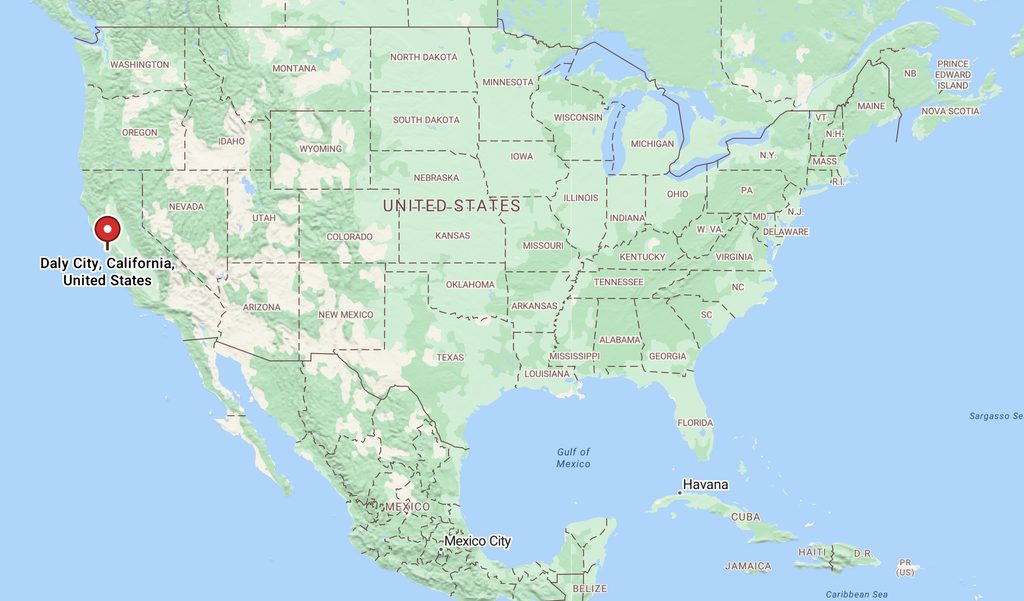
Over the following hours, the blimp would drift back towards the California coastline, eventually crashing into Daly City, a residential neighbourhood near San Francisco. When rescuers reached the aircraft, they discovered that its two-man crew had vanished.
Neither man was ever seen again.
A Coastline Under Threat
Following the Japanese attack on Pearl Harbor in December 1941, fears of further attacks spread along the Pacific coastline. Japanese submarines were operating in waters off California, Oregon, and Washington, sinking several Allied vessels during the opening months of the war. In February 1942, a Japanese submarine shelled an oil facility near Santa Barbara, one of the few direct attacks carried out against the American mainland during the conflict.
Although the threat was limited compared with events unfolding elsewhere in the war, the attacks created considerable uncertainty. Military planners knew that enemy submarines could target shipping routes and coastal infrastructure, and they needed a way to monitor vast stretches of ocean.
The Navy responded by establishing Airship Patrol Squadron 32 at Naval Air Station Moffett Field in California, the first lighter-than-air patrol squadron stationed on the West Coast during the conflict.
To equip the new unit, the Navy requisitioned five commercial advertising blimps from the Goodyear Tire & Rubber Company. Although relatively slow compared with conventional aircraft, blimps could remain airborne for extended periods and operate at low altitudes, making them well suited to searching large areas of ocean. Their crews could patrol shipping lanes, investigate suspicious activity, and help track submarines operating near the coast.
Among the aircraft assigned to this work was a blimp designated L-8. Known to its crews as Love-8, it was officially commissioned on 5th March 1942, becoming part of the coastal surveillance network operating from Moffett Field.
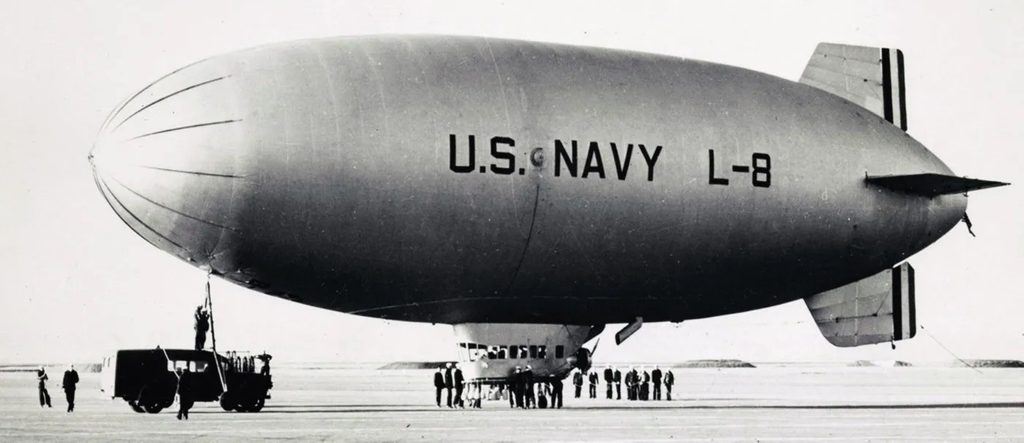
Approximately 150 feet long, the airship was held aloft by an envelope containing 123,000 cubic feet of helium. Unlike the large rigid airships of the interwar years, L-8 had no internal metal framework. Its shape was maintained by the pressure of the gas inside its flexible envelope, with a lightweight control gondola suspended underneath.
Powered by two engines, it was equipped for anti-submarine patrols with a .30-calibre machine gun and two 325-pound Mark 17 depth charges.
The Men Aboard Flight 101
By August 1942, L-8 had completed numerous patrols without incident. Its crews were experienced in operating the aircraft, and the mission scheduled for Sunday 16th August was expected to be another routine coastal reconnaissance flight.
The pilot was 27-year-old Lieutenant Ernest DeWitt Cody, a 1938 graduate of the United States Naval Academy. Despite his relatively young age, he had established a reputation as a capable and dependable aviator. He was not one to lose his head under pressure, and his commanding officer described him as one of the most capable pilots and able officers under his command. Although he had received his lighter-than-air qualification only nine months earlier, Cody had already accumulated 756 hours of airship flight time.
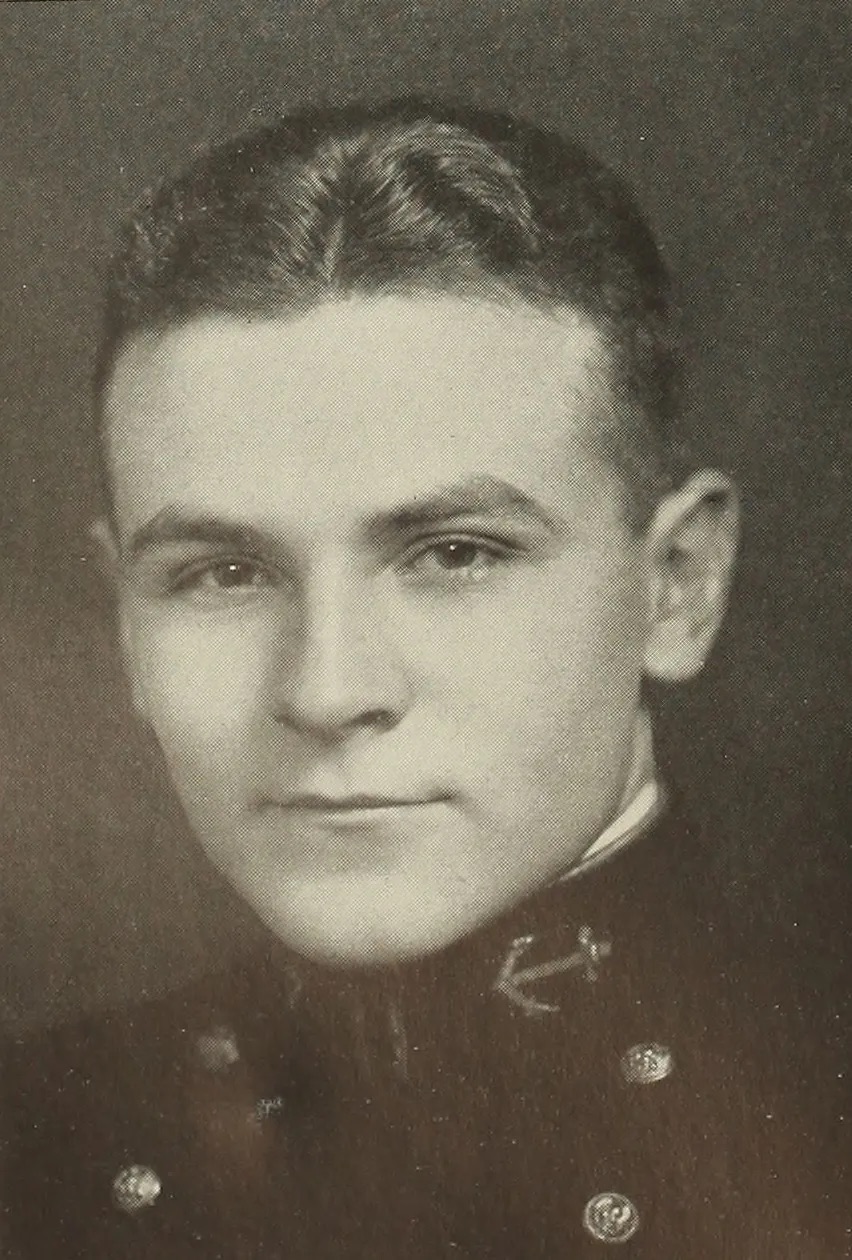
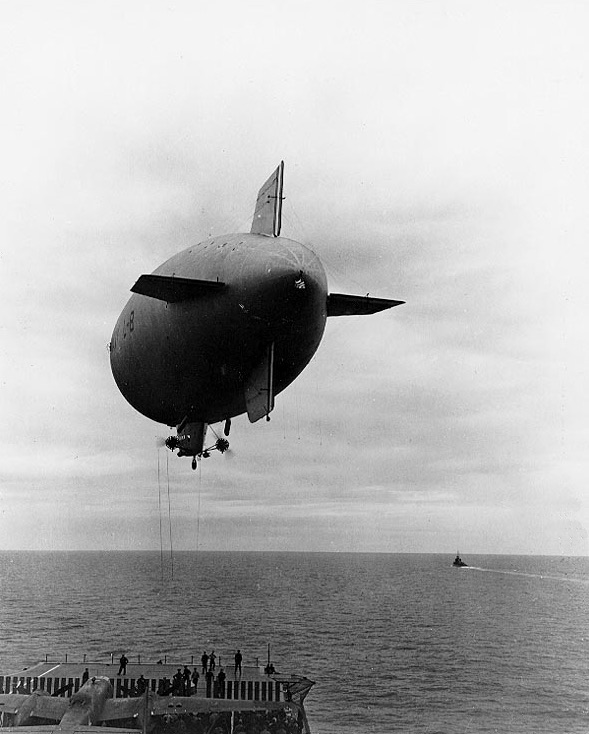
Earlier that year, he had also participated in a mission connected to one of the most significant American operations of the war. In April 1942, Cody piloted L-8 on a secret logistical mission involving the aircraft carrier USS Hornet. The carrier was preparing to transport sixteen Army Air Forces B-25 Mitchell bombers towards Japan for Lieutenant Colonel James Doolittle’s planned bombing raid on Tokyo. The aircraft required replacement engine parts, and Cody was tasked with delivering approximately 300 pounds of equipment directly onto the carrier’s flight deck.
Holding the blimp steady above the moving ship in challenging sea breezes, he helped lower the parts onto the carrier. The manoeuvre required considerable precision, and his performance demonstrated his ability to handle the aircraft in difficult conditions.
Joining Cody on the August patrol was Ensign Charles Ellis Adams, aged 34. Although Adams had only received his officer’s commission the previous day, he brought considerable practical experience to the flight.
He had spent approximately twenty years in lighter-than-air operations, accumulating 2,281 flight hours. His career included service aboard several of the Navy’s large rigid airships, including USS Los Angeles, USS Akron, and USS Macon. Adams had survived the loss of the Macon in 1935, when the airship crashed into the Pacific Ocean off Point Sur, California.
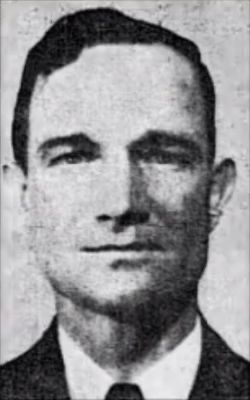
He had also been involved in rescue efforts following the destruction of the German airship Hindenburg at Lakehurst, New Jersey, in May 1937. His actions during the disaster earned him recognition from the German government.
Flight 101 was to be Adams’s first patrol as a commissioned officer.
Both men had extensive experience in airship operations, making the circumstances of their disappearance particularly difficult to understand.
The Final Patrol
On the morning of Sunday 16th August 1942, Flight 101 was scheduled to undertake a standard four-hour coastal reconnaissance patrol within approximately fifty miles of San Francisco.
The flight plan called for the aircraft to depart from Treasure Island, a man-made island in San Francisco Bay that had been taken over by the Navy and converted into a naval station. It was to pass over the Golden Gate Bridge and head towards the Farallon Islands, approximately 25 miles offshore. From there, it would continue north towards Point Reyes before turning south along the coastline and returning to Treasure Island between 10:00 and 10:30 am.
Weather conditions were generally favourable, although the skies were overcast. Visibility was estimated at between three and five miles, with light winds.
A third crewman, Machinist’s Mate James Riley Hill, known as Mick, had originally been assigned to the flight. However, during pre-flight preparations, Cody calculated that the blimp was approximately 200 pounds overweight for optimum take-off trim. Heavy moisture in the air had affected its lifting capacity, and he ordered Hill to remain behind.
At approximately 6:03 am, L-8 lifted off from Treasure Island with only Cody and Adams aboard.
The airship crossed the Golden Gate Bridge and turned southwest towards the Farallon Islands. At 7:38 am, Cody radioed squadron headquarters at Moffett Field, reporting their position as four miles east of the islands.
Four minutes later, he transmitted his second message:
“Investigating suspicious oil slick. Stand by.”
Oil slicks were regarded as possible indicators of submarine activity, making the sighting worth investigating. The crew dropped two smoke-producing float markers into the water to identify the location and began circling the area.
Several naval and civilian vessels witnessed the manoeuvres. The Liberty ship Albert Gallatin sounded its general alarm and manned its guns after seeing the smoke markers, while crewmen aboard the nearby fishing trawler Daisy Gray pulled in their nets to clear the area in case depth charges were used.
Witnesses aboard the Daisy Gray watched through binoculars as L-8 circled the oil slick at an altitude of approximately 200 to 300 feet, eventually descending to within 30 feet of the ocean surface. The trawler’s first mate later confirmed seeing two figures inside the gondola, one of whom appeared to have dark hair.
Nothing about the aircraft’s movements suggested an emergency.
However, naval radio stations were becoming increasingly concerned. Repeated attempts to contact L-8 after its last transmission had produced no response. By 8:50 am, two Vought OS2U Kingfisher floatplanes had been dispatched to search for the aircraft, and other military pilots were instructed to keep watch.
By approximately 9:00 am, the blimp had completed its low-level inspection, dropped ballast, climbed, and turned east towards the mainland. To those watching from nearby vessels, its manoeuvres appeared entirely controlled.
At 10:49 am, a commercial Pan American Clipper flying over the Golden Gate Bridge reported seeing L-8 heading inland. The airship appeared to be in normal trim.
At approximately 11:00 am, a Kingfisher floatplane spotted the blimp rising through the cloud layer near Salada Beach at an altitude of around 2,000 feet. Shortly afterwards, an Army P-38 fighter pilot also reported seeing it near Mile Rock Lighthouse. Neither sighting suggested that the aircraft was in immediate danger.
But as L-8 approached the coastline, its appearance began to change.
The Ghostly Drift and Crash in Daly City
At approximately 11:15 am, L-8 began exhibiting increasingly erratic behaviour as it crossed the shoreline. An off-duty Navy seaman travelling along the coastal highway photographed the airship, capturing its gas envelope sagging and bending in the middle.
Moments later, a bather at Ocean Beach observed the blimp drifting broadside to the wind, approximately fifty feet offshore. Its engines appeared to be silent.
The low-flying aircraft touched down briefly on the sandy beach south of Fort Funston before drifting into a nearby hillside. The impact dragged the gondola along the ground, packing the starboard engine housing with dirt and twisting its propeller blades.
The force of the impact dislodged one of the two 325-pound depth charges. It rolled down the slope and landed on a golf course near San Francisco. Thankfully, the bomb had not detonated because its pressure-operated mechanism required underwater pressure to activate.
Relieved of 325 pounds of weight, the buoyant airship rose back into the sky.
It continued drifting inland, passing over the Olympic Club Golf Course and Lake Merced. Witnesses described the sagging envelope as taking on a distorted, V-shaped appearance. Hundreds of people, including police officers and Daly City firefighters, began following the aircraft as it moved towards the base of Mount San Bruno.
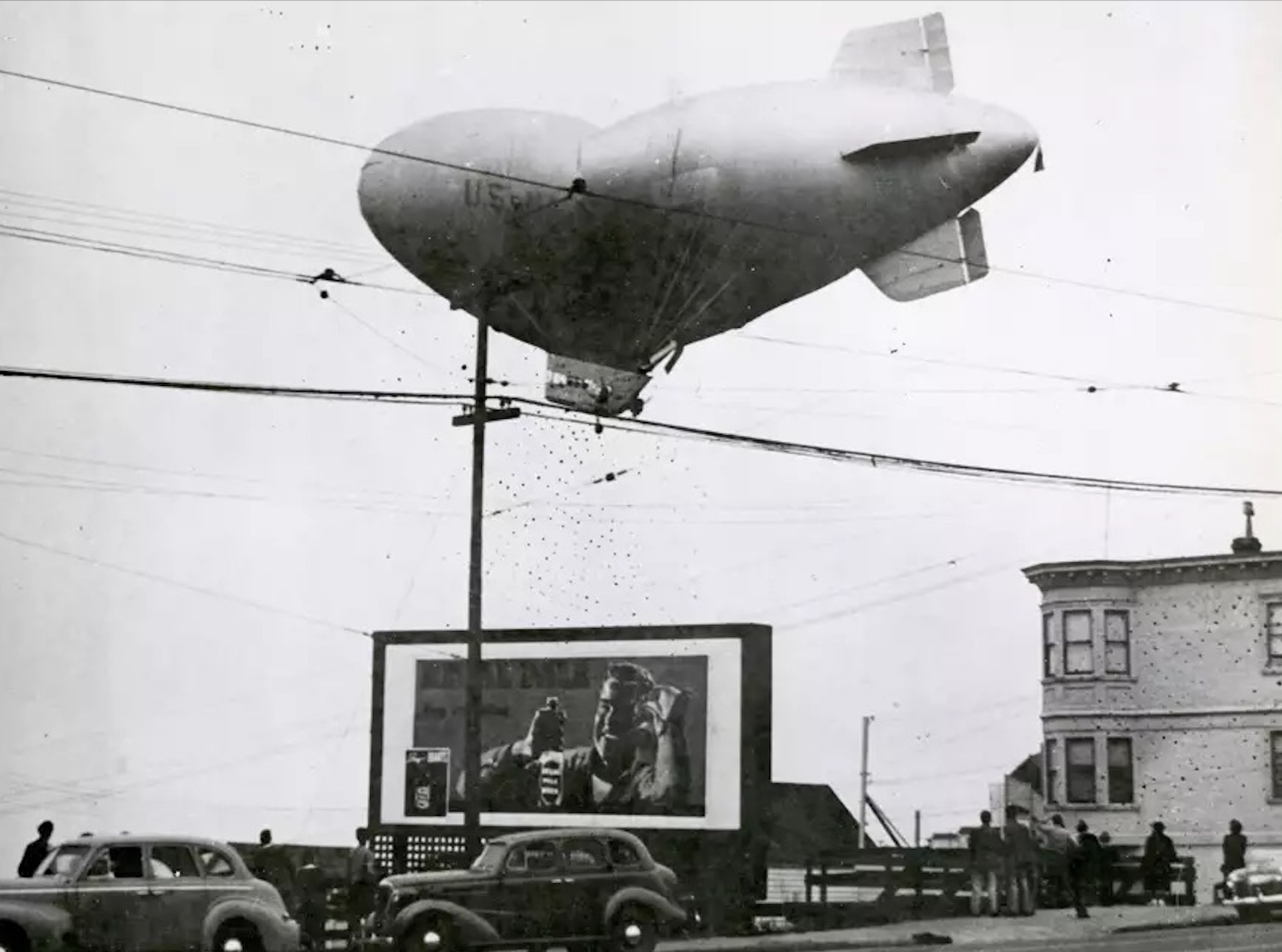
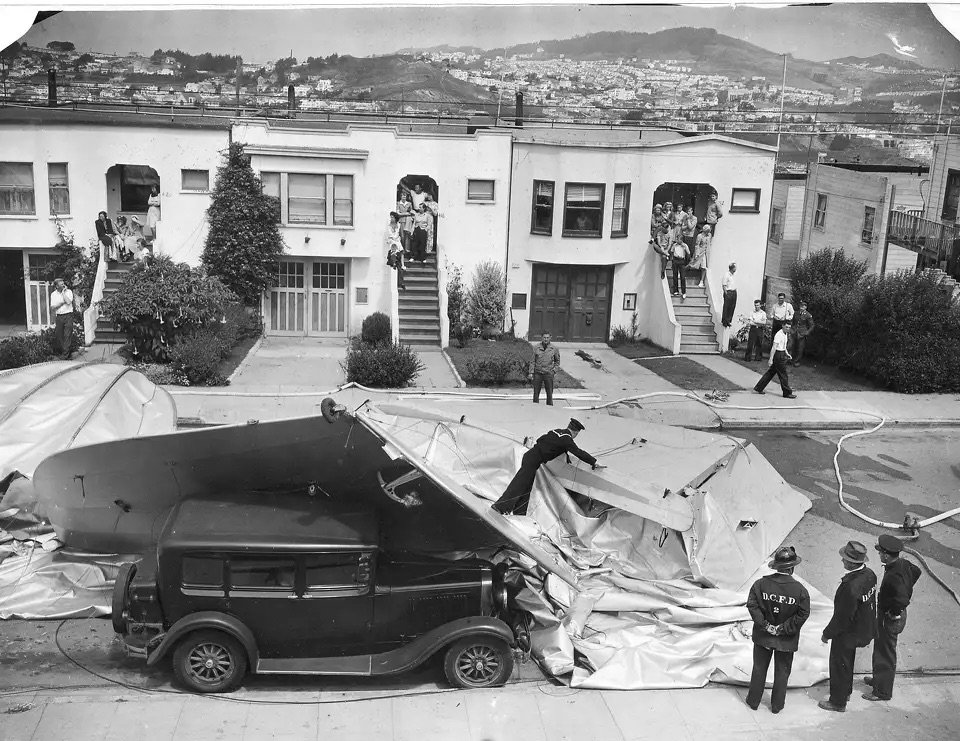
At approximately 11:30 am, L-8 made its final descent into a residential neighbourhood in Daly City. The airship struck the roofs of several houses on Bellevue Avenue. Its gondola clipped a utility pole in front of 419 Bellevue Avenue, snapping a wooden cross-arm, while the tail section caught overhead electrical wires, throwing off sparks.
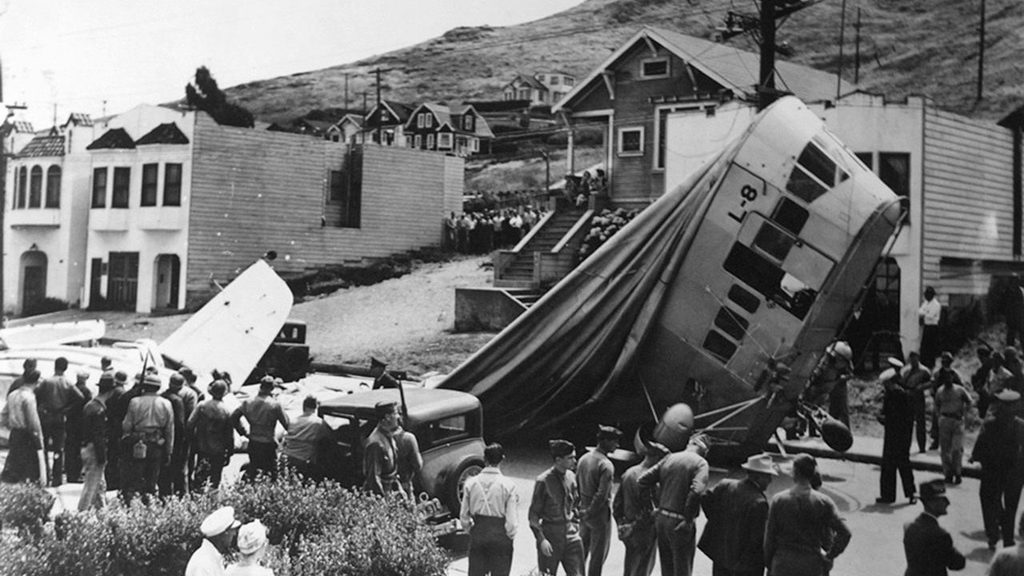
The envelope was punctured, releasing large quantities of helium. The airship rapidly lost lift and crash-landed in the middle of the street. Its gondola tilted sideways against a utility pole, while the collapsing envelope draped across a parked 1928 Dodge sedan. The car’s owner had been waxing it when the blimp came down. He hurried to get his mother to safety, narrowly escaping the falling envelope.
Chaos ensued as local residents and volunteer firefighters rushed to the scene, expecting to find the crew trapped inside the aircraft. When they reached the gondola, however, they discovered something unexpected.
There was nobody aboard.
An Empty Gondola
Lieutenant Cody and Ensign Adams had vanished.
The gondola door was found unlatched and wide open. The microphone from the Bogen Hailer loudspeaker system used to communicate with surface ships was hanging outside the doorway. Inside, the engines were no longer running, the flight controls appeared to be in order, and a crewman’s hat rested on the control console.
Further inspection revealed that much of the equipment remained undisturbed.
All three parachutes and the rubber life raft were still aboard, and the machine gun and remaining flares had not been removed. A heavily weighted briefcase containing classified radio codes remained securely locked behind the pilot’s seat. The crew had been under standing orders to throw the briefcase overboard into the ocean if an emergency arose, preventing sensitive military information from falling into enemy hands. Yet the briefcase remained exactly where it had been stowed, suggesting that the men had not taken any action to dispose of it before they vanished.
Two of the three life jackets normally carried aboard were missing. Naval regulations required aircrew to wear their inflatable life jackets during over-water operations, suggesting that Cody and Adams had been wearing theirs during the flight.
The fuel tanks still held enough gasoline to power the blimp for several hours, although investigators could not establish whether any fuel had been released from the dump tank. Normally, fuel would be released when a blimp needed to increase its buoyancy quickly.
The radio transmitter was found switched on, although its battery was in a near-exhausted condition.
Investigators also noted that the safety bar normally used to secure the gondola doorway was no longer in place. The open door was particularly unusual because it was not a position in which the aircraft would normally be operated.
Despite extensive examination, there was no clear explanation for how two experienced airmen had disappeared from an aircraft that had remained capable of flying for several hours without anyone at the controls.
The legend of the Ghost Blimp had been born.
The Search for Answers
Following the discovery of the empty airship, the United States Navy launched an exhaustive search across land, air, and sea. Coast Guard cutters, naval vessels, and search aircraft covered the waters between San Francisco and the Farallon Islands for three days. Conditions were favourable, with good visibility and relatively calm seas, but neither man was found. Their missing life jackets were never recovered either.
Two days after the incident, the Navy convened a formal Board of Investigation chaired by Commander Francis Connell. Over seven days, the board interviewed thirty-five military and civilian witnesses and conducted a detailed examination of L-8.
The investigation found no evidence of enemy action, fire, structural failure, or deliberate misconduct. However, one of the most difficult questions remained unanswered: if an emergency had occurred aboard the aircraft, why had neither man sent a distress call?
The Board concluded that the crew’s departure from the airship had most likely been involuntary.
The most plausible explanation considered by the Navy was that one of the men had opened the gondola door to investigate the oil slick or deal with a problem aboard the airship, and had accidentally fallen into the sea. One theory was that Adams had gone to the doorway to drop a smoke tracer and slipped. Cody may then have attempted to help him, perhaps manoeuvring the blimp around the area and stopping the engines before going overboard himself. With both men gone, the L-8 would have been left drifting without anyone at the controls.
However, the idea that one man deliberately jumped into the sea to rescue the other raises an obvious question. Both were experienced naval officers, and neither would ordinarily have abandoned an aircraft while its radio remained functional. A more likely possibility is that, if one man fell, the other would have stayed aboard to call for assistance and mark his companion’s position. It remains possible that both men fell accidentally, but there was no evidence to establish exactly how, or why, either man left the aircraft.
Investigators also considered the possibility that a faulty safety latch had contributed to the accident. The gondola had an external boarding ladder used when crew members needed to access parts of the aircraft, and a failure of the doorway’s safety mechanism could potentially have allowed someone to fall.
The dangling loudspeaker microphone offered another possible clue. One theory suggested that a crewman may have been attempting to communicate with someone outside the aircraft when the accident occurred.
These explanations were consistent with some of the physical evidence, but none could establish precisely what happened. Most importantly, there was no definitive account of how two experienced airmen disappeared without a distress call or any subsequent trace of their whereabouts.
Over the years, other explanations have attracted public attention.
Researcher Otto Gross proposed that the crew may have been incapacitated by secret radar equipment or microwave exposure during testing. However, no naval records or technical evidence indicate that L-8 was carrying experimental radar equipment on 16th August 1942, leaving the theory entirely speculative.
Suggestions that the men were captured by a Japanese submarine have also been examined. Witnesses aboard surface vessels monitoring L-8 reported no signs of enemy fire or submarine activity in the area. The classified briefcase also remained untouched aboard the aircraft, making a covert enemy capture difficult to reconcile with the available evidence.
Similarly, theories that the men deliberately abandoned the airship to defect or disappear are contradicted by the evidence. Personal belongings and classified materials were left behind, and both officers had exemplary service records with no known indication of an intention to desert.
At the furthest end of speculation are two particularly unusual stories.
One suggests that the men were involved in a love triangle with an unidentified woman, and that one murdered the other during the flight before escaping when the blimp reached land. The rumour has no established factual basis.
The other is the popular folklore theory of alien abduction. While frequently mentioned in discussions of the mystery, it has no scientific or factual basis and is not regarded as a credible explanation by researchers or investigators.
Of all the explanations proposed, the accidental-overboard theory remains the one most consistent with the available physical evidence. Nevertheless, it remains a theory rather than a proven account of what happened.
A Mystery That Never Went Away
One year after their disappearance, on 17th August 1943, Lieutenant Ernest Cody and Ensign Charles Adams were legally declared dead. The Navy classified the circumstances of their disappearance as undetermined, and the investigation closed without a conclusive explanation.
The blimp itself survived.
Following the investigation, L-8’s damaged envelope and gondola were repaired, and the aircraft returned to naval service as a training vessel for the remainder of the Second World War.
At the conclusion of hostilities, it was returned to the Goodyear Tire & Rubber Company. The company refurbished its control gondola and incorporated it into its commercial fleet as part of the blimp America.
During the 1960s and 1970s, the airship was seen by millions at major sporting events and public appearances across the United States. Few spectators realised that the aircraft had once been at the centre of one of the war’s most puzzling disappearances.
It continued flying until its retirement in 1982.
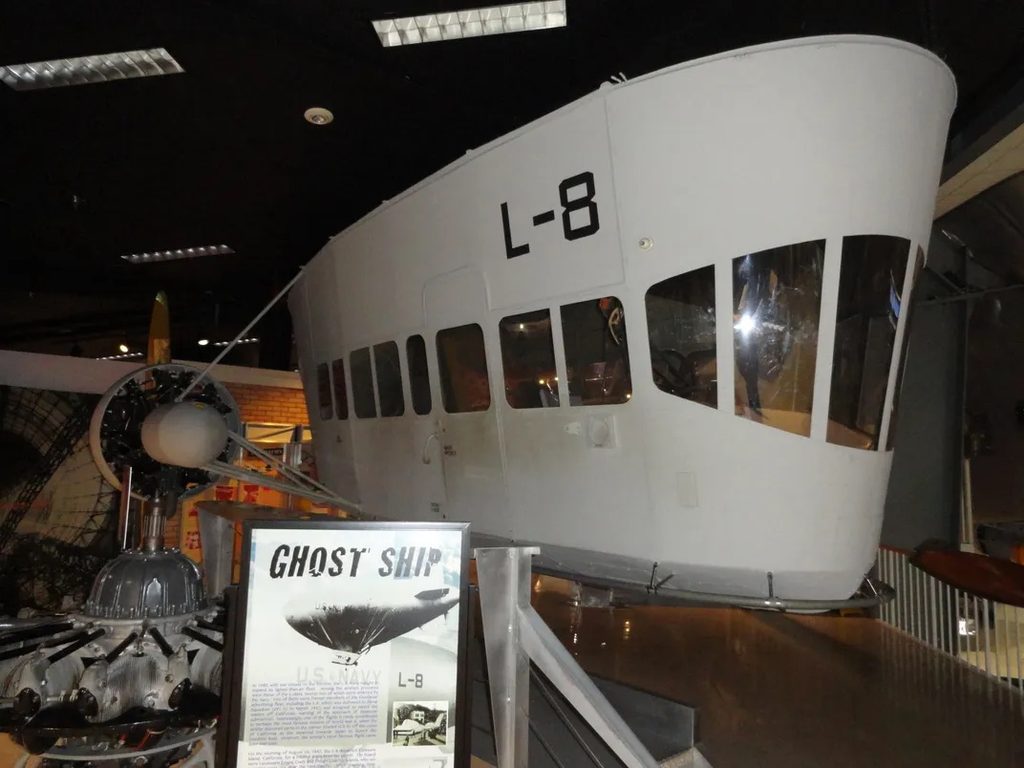
In 2003, Goodyear donated the historic L-8 gondola to the National Naval Aviation Museum at Naval Air Station Pensacola in Florida. Restored to its August 1942 military configuration and markings, it remains on public display.
What makes the story of L-8 so compelling is not the crash itself. Aircraft accidents were hardly uncommon during the Second World War. The mystery lies in the fact that witnesses saw two men aboard the blimp during its patrol, yet by the time it drifted back to shore there was nobody left inside.
The aircraft had survived. Its equipment remained largely intact, and there was no definitive evidence of what had happened to its crew.
More than eighty years later, nobody knows with certainty what happened to Lieutenant Ernest DeWitt Cody and Ensign Charles Ellis Adams.
Sources
Atlas Obscura | The 1942 Ghost Blimp That Bewildered a California Town
Find A Grave | LT Ernest DeWitt Cody
Find A Grave | ENS Charles Ellis Adams
Historynet | A Navy Blimp Took Off on a Routine Patrol Off the Coast. Its Crew Would Never Be Seen Again
SFGate | Ghost blimp’s enduring mystery: How did crew vanish before Bay Area crash?
SFGate | In 1942, a war blimp fell out of the sky onto Daly City. Its crew was never found
Skeptoid | The Riddle of the L-8 Blimp
Smithsonian | The 80-Year Mystery of the U.S. Navy’s ‘Ghost Blimp’