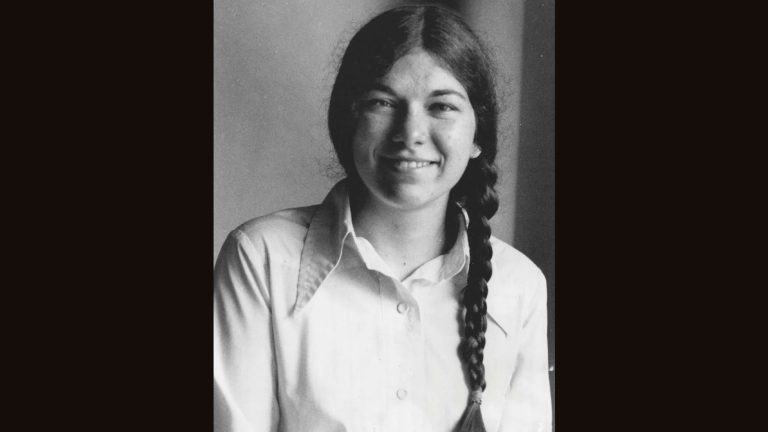
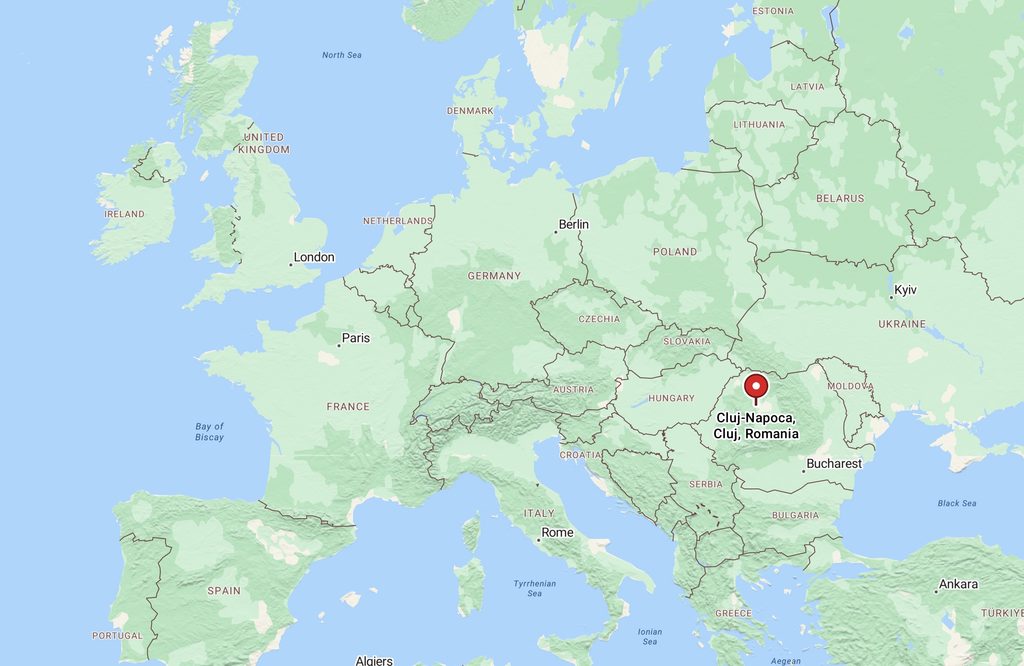
Between 1972 and 1974, a series of brutal attacks left the Romanian city of Cluj gripped by fear. Women and girls were being struck without warning, sometimes in the supposed safety of their own homes, while the man responsible remained frustratingly elusive. The press called him the Man with the Hammer, but when investigators finally uncovered his identity, they encountered something far stranger than they had anticipated: a man who believed sinister forces were controlling his every move.
His name was Romulus Vereș, and in his mind, the real killer was Satan.
The Man Behind the Hammer
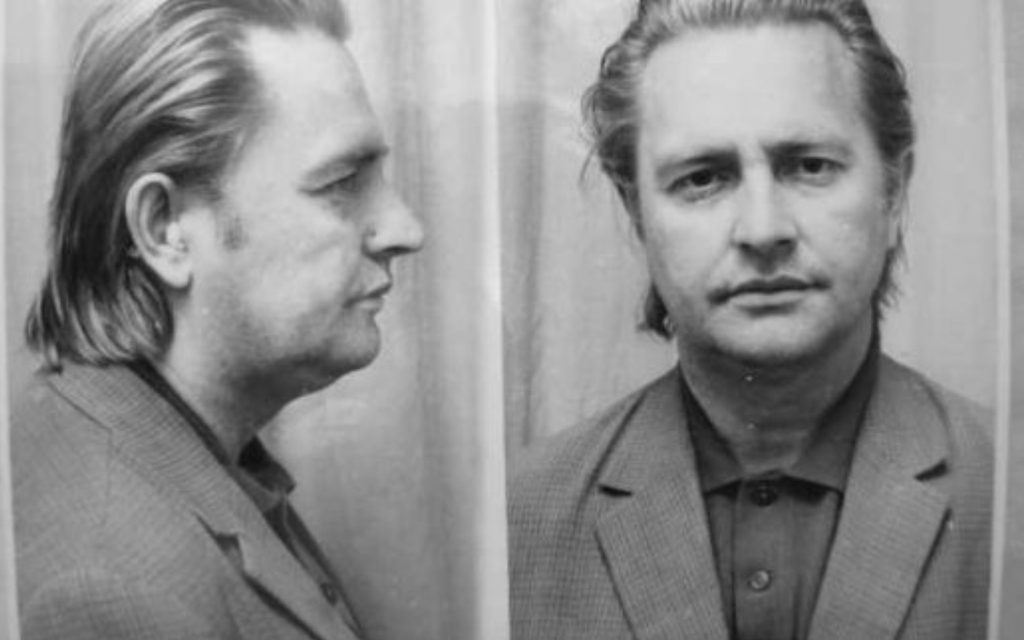
Romulus Vereș was born in 1929 in Cluj, into a modest working‑class family shaped by folklore, superstition, and the instability of interwar Romania. During the Second World War, as fighting and bombardment spread across the country, his family fled the danger, first moving to Brașov and then to Timișoara before returning to Cluj, where Vereș spent the rest of his life. By the time Vereș reached adulthood, Romania had become a Communist dictatorship. This regime denied the existence of violent crime, censored anything supernatural, and used psychiatric hospitals as tools of control. This was the world he grew up in, and the world in which his later attacks would occur.
As a young man, Vereș followed a very ordinary path. He completed seven classes of schooling and then attended a vocational programme to become a locomotive driver, which was a respected and stable working‑class job in post‑war Romania. He trained in Brașov, specialised in Cluj, and worked for the Timiș and later the Cluj railway region, where colleagues described him as skilled, reliable, and technically competent.
His personal life, however, was far less stable. He married three times in total, and every relationship ended in violence, infidelity, or chaos. His first marriage at 19 produced a son, also named Romulus, but collapsed after six years. His second wife lasted four years before leaving, later telling investigators that he beat her and once brought home an 18‑year‑old girl, introduced her as a ‘maid,’ and put her in the same bed with them. After that divorce, he lived with the ‘maid’ until 1967, while simultaneously pursuing other girlfriends, some of them minors, whom he courted with gifts and charm. By 1968 he had married again, to Etelka Păcurar. This marriage also ended in divorce, with Etelka accusing him of abuse and serial cheating.
By the late 1960s, cracks were showing everywhere. In February 1968, while driving an accelerated passenger train, Vereș ignored repeated stop signals and blasted through Huedin station at full speed, telling his protesting colleagues to be quiet because he was the one driving. He explained the incident through his delusion, saying he was being influenced by satanic forces that had taken control of his hands, and that he couldn’t stop the train because “they” were controlling him. It was one of the first clear signs that his mind was slipping into psychosis.
“You should shut up. I drive this train and no one tells me what to do. Satan has commanded me not to stop, and I must submit to Satan.”
The incident endangered hundreds of passengers and led to his dismissal. Refusing to accept his firing, for nearly three years he fought to be medically retired instead, allegedly bribing a railway official with a Fiat car to secure the psychiatric certificate he needed. He was finally granted medical retirement at just 40 years old, following a diagnosis of persistent depressive neurosis, hypertension, and cervical spondylosis.
By 1972, Vereș was living a double life: outwardly charming, with four mistresses at the same time, yet increasingly unstable and violent. And within months of leaving the railway, the killings began.
The First Murder: Cornelia Vaida
On the night of 11th September 1972, 28‑year‑old Cornelia Vaida left her boyfriend’s home in Cluj and began the familiar walk back to the dormitory where she lived. It was a forty-minute walk and a route she had taken many times before.
She reached her building shortly before midnight. She stepped inside, walked down the hallway, and was only a few steps from her room when someone struck her three times on the head with a hammer. She collapsed, unconscious. The attacker lifted her in his arms, carried her through the vegetable garden behind the dormitory — where investigators later found pools of blood — then crossed the road to the edge of a small park. There, he removed her clothing and threw her into the River Someș. Her body was carried almost a mile downstream before being discovered the next morning.
At first, the case looked like a drowning. But the fact that she was naked raised immediate suspicion, and the autopsy revealed she had been attacked with a blunt object before entering the water. Whether she was sexually assaulted could not be determined. Her watch and clothing were missing.
The investigation began with the obvious suspects, like her boyfriend, who had been the last person to see her alive after she had left his home in a hurry, forgetting her umbrella. Residents of the dormitory were interviewed one by one. A neighbour known for harassing women briefly became the focus, but investigators had nothing solid to hold him on.
For months, the case went nowhere. It was only after a year and a half, and after more women were attacked, that investigators connected the murder to Romulus Vereș, a 43‑year‑old former locomotive driver. And when they did, a disturbing detail emerged: according to a friend of the victim, Cornelia had briefly dated Vereș three years earlier in 1969, meaning that his first known victim was not a stranger.
A Series of Attacks
Before investigators made the connection to Vereș, Cornelia’s murder marked the beginning of a series of attacks that would terrorise Cluj for the next eighteen months.
Ibolya Covaci
On the morning of 7th October 1972, 15‑year‑old Ibolya Covaci was asleep in her house in Cluj. Her mother had already left for work, and the neighbourhood was quiet. Ibolya woke to the sound of someone rummaging through the wardrobe in her bedroom. When she opened her eyes, a stranger was standing in the room.
He told her to get dressed, then he led her to the kitchen and ordered her to fetch some papers from the same wardrobe he had been searching. When she refused and shouted at him to leave, he struck her repeatedly on the head with a blunt object. She collapsed, and he undressed her, placing her on the padded kitchen bench. For a moment he simply stood there, watching her. Then he gathered her clothes, took two broken wristwatches he had found in the wardrobe, twisted the key in the front door, and left her locked inside the house.
Ibolya lay in a pool of blood for seven hours before her mother returned home and found her. She was rushed to hospital and taken straight into surgery. Against all odds, she survived.
When she was able to speak, Ibolya told the police that her attacker was a young man with brunette wavy hair. Investigators had no reason to suspect Romulus Vereș yet; in fact, the description would have ruled him out because Vereș was blond with hair that fell low at the back. It was only much later, after his arrest, that witnesses mentioned he sometimes dyed his hair black and curled it, a detail confirmed after the police searched his home over a year later and found a bottle containing traces of hair dye.
Meanwhile, fear was spreading through Cluj. Women whispered about a man who attacked with a hammer, who killed, who raped, who prowled the streets at night. Colonel Augustin Nona, then a young lieutenant, later recalled the atmosphere:
“Everyone was talking about the Man with the Hammer. But there was no evidence that he killed or attacked with a hammer. It was only supposed, and that’s where all the rumours came from.”
But regardless of the weapon, people were right to fear him. He was dangerous, and his attacks had only just begun.
Maria Mărgineanu
On the morning of 16th October 1972, nine days after the attack on Ibolya Covaci, Maria Mărgineanu, a 35‑year‑old woman in her eighth month of pregnancy, followed her usual routine. After her husband left for work, she walked her young daughter to school, then stopped at a nearby tobacconist. She bought a reel of white thread and a lottery ticket sealed in a 3‑lei envelope. Expecting to return home quickly, she had left her front door unlocked, with the key still in the lock.
When she got home, Maria set her shopping down and went into the yard to feed the chickens. A few minutes later she stepped back into the kitchen and took only a few steps before she was struck violently on the back of the head. She collapsed onto the floor.
Vereș fled immediately. Before leaving, he took a wristwatch from an ashtray on the table and 200 lei from the pocket of a coat hanging in the wardrobe. As he had done before, he twisted the key in the front door and left with it, locking the victim inside her own home.
Maria lay unconscious for hours. She was found around midday by her daughter, who returned from school to discover her mother on the kitchen floor. Maria was rushed to the hospital, where doctors managed to save both her life and her pregnancy.
The attack deepened the growing fear in Cluj. By now, three women had been attacked inside their own homes — one killed, two left for dead — all struck with a hammer. But still, the police had no suspect, no motive, and no clear direction.
Ana Valentina Florea
For over six weeks after the attack on Maria Mărgineanu, Cluj was quiet. Then, on the eve of St Nicholas, the Man with the Hammer returned, and this time his victim was a child.
On the morning of 5th December 1972, 8-year-old Ana Valentina Florea was getting ready for school in the basement flat where she lived with her parents. Their home was part of the railway workers’ neighbourhood near the CFR Stadium — a tight‑knit community built around the state railways. Her mother and father had already left for work, leaving the front door unlocked and the key in its usual place inside the house, as they did every morning.
Ana was struggling to put on her shoes when a stranger stepped into the hallway. He was dressed in military clothing — a detail that would later confuse the investigation — and he asked her what she was doing. He took her shoe, threw it to the floor, and then struck her twice on the head with a heavy iron tool. She collapsed.
What happened next was the most brutal escalation yet. After attacking her, Vereș raped her, then set fire to the house, igniting clothes inside the wardrobe. Before leaving, he locked the front door with the key he had found and took it with him, trapping the unconscious child inside.
Smoke was soon seen rising from the building. Neighbours forced the door open and stumbled over the iron tool the attacker had used. One man pushed through the flames and carried Ana out, saving her life. She was rushed to hospital for emergency surgery.
Later forensic examination recovered a pubic hair belonging to Vereș on Ana’s hair — one of the few pieces of physical evidence he ever left behind.
Ana’s father, who worked at the Cluj locomotive depot, knew Romulus Vereș personally. Three weeks after the attack, the two men met by chance on the street. Knowing the girl had survived surgery, Vereș expressed sympathy, asked after her condition, and then, astonishingly, offered ‘information’ about possible suspects. He claimed he had travelled from Bucharest in September in the same train carriage as two men who said they knew Ana’s father and wanted to visit him. One of them, he emphasised, wore a khaki military blouse without epaulettes.
The entire story was fabricated. Vereș had attacked Ana while dressed as a soldier, and now he needed to reinforce that false identity. By pointing to two supposed soldiers from Bucharest, he hoped to push the investigation toward long‑distance travellers and away from local men like himself.
By now, Cluj had endured one murder and three attempted murders in just three months, all carried out with sudden, blunt‑force attacks, all targeting women and girls, all committed in the same small radius near the River Someș. But the surviving victims gave conflicting descriptions. One said the attacker was a civilian with brown hair. Another said he was a soldier with blond hair. And the police had no fingerprints, no clear suspect, and no idea that the man they were looking for lived and moved within the very same small area as all the victims.
Ana Biro
On the evening of 12th December 1972, just a week after the attack on Ana Florea, the Man with the Hammer struck again.
Ana Biro, 48, worked as the manager of a small bread shop in the square near the train station — the same railway‑worker district where many of the earlier victims lived.
At around 7:50 pm, while she was counting the day’s money, a thin, blond man of medium‑short height walked in. He kept his right hand in his coat pocket and asked if she had yeast. Without looking up, she told him to try the grocery shop next door.
Vereș then took the opportunity and hit her on the head with a hammer.
Ana didn’t fall. Instead, she screamed, loudly enough that several men in the square ran toward the shop. The attacker fled, sprinting across the square and disappearing up a steep railway embankment. Witnesses chased him as far as the Railway Park, but he escaped, eventually boarding a bus into the city centre.
Militia officers arrived quickly, and sniffer dogs traced his exact route from the bread shop to the bus stop.
Ana never saw her attacker’s face. She had been bent over the counter, focused on her calculations, and didn’t look up when he spoke. The blow came so fast she only registered the curved shape of the hammer.
It only came to light later that her husband, a former locomotive stoker, had once met Romulus Vereș through railway work. This was a retrospective detail showing how often he moved within communities he already knew, but not something Ana herself could have recognised in the moment.
After attacking Ana, Vereș didn’t go home. He stayed out, walking the streets, and just after midnight, he struck again.
Ioana Oltean
Ioana Oltean was a 46‑year‑old radio‑centre operator who was returning home from her late shift. She lived in a block of flats and was waiting for the lift when a man entered the hallway behind her. She later said he made her uneasy, but she stepped into the lift first anyway, and he followed. As the doors closed, he struck her on the head and ran.
Her injury was superficial, and her screams brought neighbours out onto the stairwell. They gathered her belongings, helped her upstairs, and tried to understand what had happened. However, Ioana told them she had simply fallen and felt unwell, and did not report the attack immediately. Only later, after speaking to her husband, did she go to the Militia.
From the start, investigators felt something was off. Her statements were contradictory, and her description of the attacker shifted. She even claimed the attacker was “a masked man with black hair,” a strange and inconsistent detail that immediately raised investigators’ suspicions, especially since she had willingly stepped into the lift with this masked stranger. It became clear later that she was trying to disguise the fact she knew him personally, a truth that only emerged after Vereș was eventually caught.
Ioana had been one of his mistresses. She had recently begun avoiding him, and the attack appears to have been a mixture of anger, impulse, and opportunity. She admitted later that she had not wanted to “cause problems” for him and was worried about the shame of people in Cluj knowing she had been involved with him.
The situation became even more tangled when it emerged that Ioana had seduced the Militia major assigned to check on her. She had obtained information about the investigation from him and received advice on how to handle questioning. Case documents describe her as manipulative and sexually opportunistic, but she could not be charged with aiding the killer because she was also legally a victim.
Protected by Ioana’s silence and emboldened by escaping twice in one night, Romulus Vereș would kill again before the month was over.
The Second Murder: Aurelia Ciulea
Aurelia Ciulea was a quiet, studious 16‑year‑old who lived as a lodger in a modest courtyard house in Cluj, only a few doors from the Militia headquarters. She was a scholarship student, withdrawn, diligent, and entirely unaware she’d been noticed by the Man with the Hammer days earlier.
Vereș had learned Aurelia’s routine from yet another mistress, Ana Nagy, a woman he had known since she was 15. She described him as her protector, a man who gave her gifts and money, and whom she continued to meet even after marrying and having three children. During one of his visits, he had looked out of her kitchen window, seen Aurelia at the courtyard fountain, and asked who she was. He pressed for details, like when the girl was home, when she left for school, and who else lived around the shared courtyard. A few days before the murder, he even asked Ana what time she and her children would be out of the house that week.
On the morning of the 16th December, Vereș waited until the residents left for work one by one. He then slipped into his mistress’s house using the spare key he knew she kept hidden. From her kitchen, he took a wooden‑handled kitchen knife, replaced the key exactly where he’d found it, and crossed the yard to the house where Aurelia lived.
Aurelia was alone in the kitchen, quietly drawing a geography map for school. Investigators believed that because he was a familiar face she had seen visiting a neighbour around the shared courtyard, she opened the veranda door for him. Once inside, he attacked her with the knife, stabbing her seventeen times.
After killing her, he raped her. Before leaving, he opened a cupboard window and stole a wristwatch, then took 500 lei from her purse. He attempted to set several small fires, first to a crocheted tablecloth, then to the carpet, before finally igniting the sheets inside a wardrobe. The flames spread through the room as he locked the door behind him and took the key.
Prosecutor Iuliu Andrei was one of the first inside. He later recalled spending hours in the room, searching for anything the flames hadn’t consumed. Aurelia had fought back fiercely, and investigators found two strands of blond hair clenched in her left hand, with two more elsewhere in the room. With witnesses giving contradictory descriptions — some insisting the attacker was dark‑haired, others swearing he was blond — these hairs were the only solid clue the Militia had. Andrei kept them “like holy relics,” convinced they would one day identify the killer.
When Ana Nagy later learned that Aurelia had been murdered and that the killer had taken the knife from her own kitchen, she suspected the person responsible was Vereș. She became certain when he abruptly stopped visiting her. But going to the authorities would have meant admitting to an affair and exposing herself to judgement, scandal, and scrutiny. Plus, she had no proof, only a terrible suspicion, so she still did not go to the authorities. At that stage, the Militia knew nothing of her suspicion, and the investigation moved on.
By late December, the investigation widened into a city‑wide search. Officers walked the entire district on foot, mapping every location where the killer had struck. All the attacks clustered around the railway station, the River Someș, and the working‑class neighbourhoods surrounding them. Lists of psychiatric patients were pulled, with more than a thousand files reviewed. Officers from across the county were brought in. But the harder the Militia searched, the more frightened the city became.
Fear spread through Cluj like a fever. People began seeing the “Man with the Hammer” everywhere. One day, prosecutor Andrei was urgently summoned to a block of flats in Mănăștur. A woman refused to open the door to her own husband, insisting he was the killer. Andrei tried to reassure her, identifying himself as the chief criminal prosecutor, but she shouted an insult back through the door and still refused to open it. He left shaking his head. The city was in a state of collective panic.
Weeks passed. The attacks stopped, but the investigation went nowhere. Raids were constant, patrols multiplied, and civilian volunteers were recruited to walk the streets at night. Former prisoners, vagrants, and known offenders were all checked. Nothing matched. The killer remained free.
Then, on the 13th February, 1973, a civilian spotted a blond man pasting strange posters on the wall of the 23rd August cinema on Horea Street. The Militia detained him in Mihai Viteazul Square. It was Romulus Vereș.
This was actually Vereș’s second contact with the authorities. The month previously, he went to complain about a 70‑year‑old neighbour he believed was hypnotising him and attacking his mind. The party activist he spoke to, Jipa Ștefan, found his behaviour disturbing enough to flag him as a possible suspect, but this was a warning the Militia ignored.
By the time Vereș was detained in February, he had already made five posters using letters he had carved from soft rubber and hand-inked. Some of the posters even had a 5‑lei tax stamp glued to them. The tax stamp was his attempt to make the posters look official rather than the product of his delusion. They carried the same paranoid accusations he had been directing at his elderly neighbour, but phrased in the impersonal language of his delusion: “It hypnotizes you, it hits your brain, it sexually rides you.”
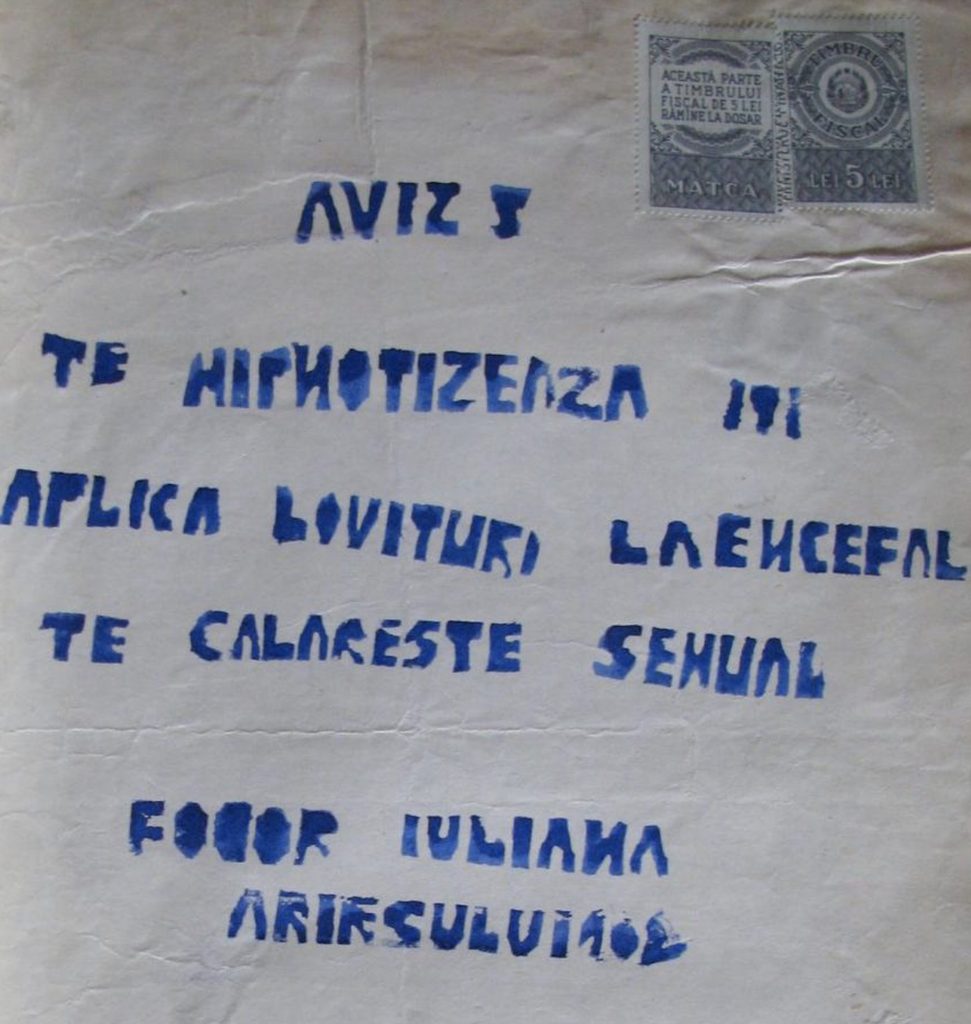
A body search revealed he was carrying a wooden‑handled knife and five small packets of human hair. His shirt, worn under his jacket, had visible blood spots.
His shirt was taken for testing, but the samples and results vanished into the chaos of the case files. The knife and the bundles of hair also disappeared. The report was written in haste, and the investigators, who were convinced they were dealing with a harmless eccentric, decided he posed no criminal threat. He was sent for psychiatric evaluation and transported to the hospital in Cluj, where he was diagnosed with paraphrenia — a psychotic disorder in which someone can appear organised and functional while living under the influence of fixed delusions — and treated with neuroleptics and induced sleep therapy. He was discharged on 6th March 1973 as “improved.”
When Vereș returned home, he quietly destroyed any evidence that could incriminate him: the hammer, the stolen watches, the clothing, the keys. Subdued by the heavy medication he’d been given when he was discharged from the psychiatric ward, Vereș committed no further attacks for the next year.
But the calm was only on the surface. In his room he kept a calendar, and on each day he wrote the same sentence:
“I am hypnotized and taken to the families in the block where they work with Satan on exterminations and murders, producing differentiated genocides.”
To him, these daily entries were a record he believed proved that people around him were attacking, controlling, and persecuting him. Each repetition reinforced the delusion that the conspiracy was real and ongoing.
It was the clearest sign that he had not “improved” at all. He was deteriorating, and soon the Man with the Hammer would kill again.
The Final Murder: Ilona Szilagy
The final killing came on 14th February 1974, more than a year after Vereș had first been detained and hospitalised. The victim was Ilona Szilágyi, an 84‑year‑old widow who lived on Yugoslavia Street in Gheorgheni, a different district from the railway‑station area where he had attacked before.
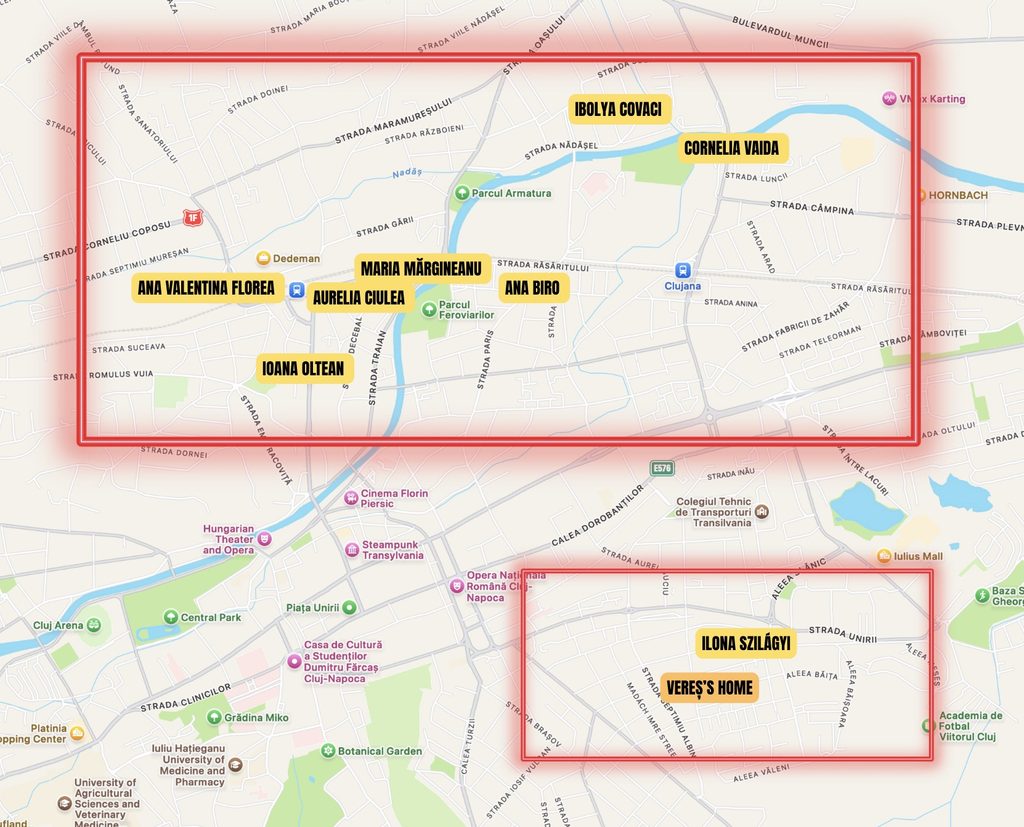
That morning, before dawn, Ilona was boiling milk on the stove when Vereș entered her home, picked up the empty one‑litre bottle she had just used, and struck her on the head. When she fell, he pressed a pillow over her face until she suffocated, then set fire to the pillows beneath her head. The flames spread quickly, leaving the room blackened. Forensic specialists later said they could not determine whether she had been sexually assaulted.
With the killer striking again after more than a year of silence, and in a completely different part of the city, the Militia panicked. They had exhausted every lead, and this latest murder made it clear they were out of their depth. They urgently requested help.
Colonel Dumitru Ceacanica, a legendary forensic specialist, was flown in from Bucharest to take over the investigation. His presence changed everything. He was direct, relentless, and intolerant of sloppy work. Within hours, he had the team re‑interviewing witnesses, re‑examining evidence, and rebuilding the case from the ground up. Because the murder had taken place in a completely different part of the city, he immediately requested the files of mentally ill individuals registered in the Gheorgheni district. After studying the case for several days, his conclusion was blunt: “We are looking for a mentally ill person.”
On 26th February 1974, Ceacanica and Nona began visiting addresses posing as Health Directorate staff conducting routine checks. They reached a block on Arieșului Street, close to Yugoslavia Street, and climbed to the apartment of one of the men on their list. He denied being ill and sent them away. As they descended the stairs, Ceacanica noticed the cleaning lady and asked whether anyone ‘odd’ lived in the building. She told them a man the neighbours found strange had recently moved in on the fifth floor. She pointed them to Veres’s door.
They knocked on his door for several minutes before he opened it a crack, leaving the chain still on. He was naked except for his underwear and began shouting and swearing at them. Through the gap, Ceacanica saw dozens of matchboxes scattered across the floor and immediately made the connection to the fires set at the murder scenes. He told Nona that this was the man they were looking for. Stretcher‑bearers were called, and when they arrived by lift they caught Vereș as he tried to leave. He was restrained in a straitjacket and taken to the psychiatric hospital.
Once Vereș was removed, the investigators entered the flat. The first thing they saw was the doors covered in scrawled messages, dates, and rambling references to Satan. Inside the wardrobe, he had written directly onto the wooden panels, filling them with daily notes, part of a pattern of obsessive note‑taking that stretched back years. Several men’s shirts hung neatly inside, each concealing a notebook tucked into the fabric. More notebooks were stacked on shelves, along with a 1973 calendar filled with day‑by‑day entries.
This was not the room of a man who had “improved.” It was the interior of his delusional system made physical. It was a place where he documented, catalogued, and reinforced the voices and conspiracies he believed controlled him.
On a table lay prayer books beside a forensic medicine treatise, heavily annotated in the sections on head injuries and violent deaths. Two books on sexual behaviour were marked and underlined in passages describing perversions. Medicines for impotence were scattered nearby. In a drawer, investigators found five bundles of hair. Vereș later explained that after seeing a barber sweep away his cut hair, he became convinced it could be used to cast spells, so he began cutting his own hair at home, collecting it and burning it.
His apartment also contained a disturbing assortment of objects: watches he claimed to repair, dozens of unrelated keys, and women’s underwear.
The notebooks were the most revealing. The earliest entries, from 1968 to 1973, began as simple observations about neighbours, but over time dissolved into a dense, elaborate system of persecution. He wrote of tiny hallucinations that carried enormous meaning for him, once telling investigators he had seen “a vision in a grain of tears,” a fragment of the distorted sensory world he lived inside. He wrote about “the owners of Satan,” and told investigators there were two Satans — Puiu, who took his psyche, and Bere, who put him to sleep and transported him somewhere he could not describe. He wrote about disguises, hair dye, and changes of clothing meant to avoid recognition by the people he believed were using satanic forces against him, and described a constant sense of being watched and manipulated, convinced that disguises were his only protection.
During questioning, Vereș denied every attack. He told investigators, “I am a fearful man. When I see blood, I feel sick,” trying to present himself as someone incapable of violence.
As the interviews continued, he became increasingly confused. Romanian reports describe him insisting he couldn’t remember the assaults at all. Instead of admitting anything, he shifted responsibility onto something supernatural, claiming that an evil force had “used” him, that it had taken on his appearance and acted through him.
These weren’t confessions. They were fragments of a persecutory delusion. In his mind, he wasn’t the killer. Something else was.
In June 1975, a commission of psychiatrists diagnosed Vereș with systemic paraphrenia, a severe psychotic disorder marked by hallucinations, fixed delusions, and a distorted sense of reality. They concluded he lacked the capacity to understand his actions. A forensic psychologist later explained that his delusions had their own internal logic, which made his behaviour appear organised even while he was profoundly psychotic.
A month later, Prosecutor Iuliu Andrei ordered that Vereș be removed from criminal prosecution and placed under compulsory psychiatric internment. In his decision he wrote that Vereș lived a double existence, and that the real “Satan” committing the murders was the defendant himself — meaning that the part of him that killed and the part of him that blamed Satan were the same mind split in two.
Vereș was committed to the psychiatric hospital in Ștei, where he spent the rest of his life. Staff later described him as calm and rarely requiring injections, but he remained deeply delusional, holding constant conversations with Bere, one of the satanic figures in his belief system.
The city of Cluj had wanted to see Vereș sentenced to death, and had he been found sane, he would almost certainly have faced execution. Instead, he lived another twenty years in the hospital at Ștei, dying of liver disease in 1993.
Sources and Further Reading
Research note: This article draws on Romanian newspaper investigations, historical case reporting, and retrospective interviews with investigators involved in the case. Some accounts differ in their descriptions of events and evidence, and certain details remain difficult to establish conclusively. Where sources conflict, the narrative reflects the most consistent available information.
Libertatea | He is the criminal who terrified Cluj
Monitorulcj | “The man with the hammer”, the serial killer who scared Cluj! 5 people, killed in 2 years